Brief
This page will be updated to show current terminology and concepts used in the Pragmatic Model of Reality.
Terminology Update
The terminology I use for modeling consciousness and ITC is evolving as I seek to make the models easier to understand and more consistent with the (apparent) actual nature of reality.
Remember that I am an engineer writing about concepts “owned” by academic philosophy and psychology. While academics typically write to communicate with their peers, often using “inside baseball” terminology, engineers try to use descriptive terms recognizable by the lay community. I suspect that much of the confusion about, and rejection of my models comes from that Academic-Layperson Partition.
The four diagrams referred to are in this post. A more detailed explanation of the is in Elements of a Useful Theory of Consciousness.
Here are the more important terms:
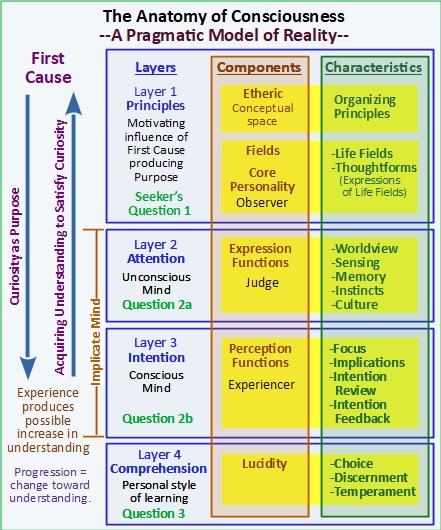
- The overall model is referred to as a “Pragmatic Model of Reality.” I say it is “A” model because I do not claim it is the only or the best. (It is but a layperson should be mindful of his or her place in academia. 😊 ) The Anatomy of Consciousness Diagram (Figure 1) is an overview of the Pragmatic Model.
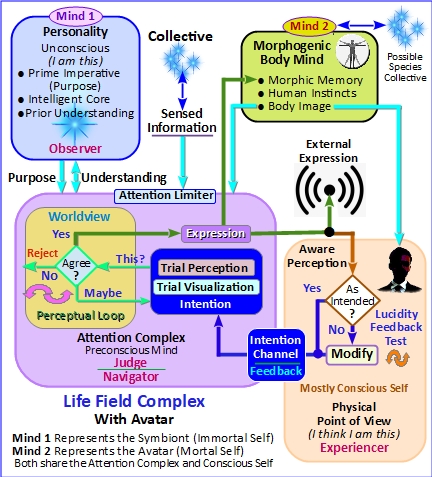
- As shown in The Anatomy of Consciousness Diagram (Figure 1) reality is modeled as for Layers: I.) Principles, 2.) Attention, 3.) Intention, 4.) Comprehension. Layers 2 and 3 represent “Implicate Mind” illustrated in Figure 2.
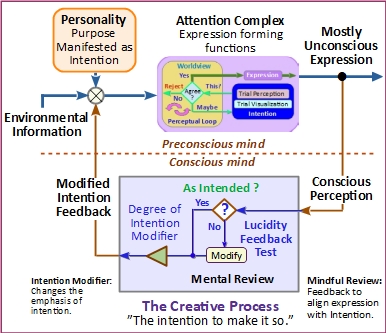
- Layer 2 represents the “Preconscious” mind. Its primary function is to sense thoughtforms, characterize them according to worldview and express that colored understanding as personalized thoughtforms.
- Layer 3 represents conscious (aware) self. Its function is to perceive and develop conscious awareness of the expression output of Layer 2. This functional area includes a “Is this what I intend (want)?” decision that produces a feedback signal that may modify worldview. See “Conscious Self and Creative Process” (Figure 3)
- The Implicit Cosmology nomenclature is being replaced with “Implicate Mind” which is Layer 2 and 3 of the Pragmatic Model (Figure 3) The Attention and Intention functions are the essence of a life filed.
- I am characterizing the model as a “function, process and relationship model.” The functions and processes of the model that I identify are not unique to me or even novel in science. Perhaps the relationship part is, however. Again, I tend to describe these known functions in engineer-talk that may make them unrecognizable to mainstream scientists.
- I am characterizing reality as a dimensionless singularity that is conceptually infinitely large. This is a little different from the idea that Psi information is everywhere as if holographic (here is everywhere). I say, everywhere is here.
- When saying reality consists of life fields (aka implicate mind) and their expressions, I am describing a life field as:
- A Purposeful Agent – This functional area represents a life field’s interface with its parent and sibling life fields (collective). It represents inherited purpose and prior understanding. Personality motivated by curiosity. In terms of Figure. 1, this is Layer 1 – Principles which represents the fundamentals of reality.
- A Meaningful Agent – This functional area examines sensed information and produces expression as a streaming signal representing understanding of information based on worldview. Functionally, this is the mind aspect of the life field. In terms of Figure 1, this is Layer 2 – Attention (preconscious) function.
- An Experiencing Agent – This functional area perceives and tests the understanding expressed by the Meaningful Agent and produces an Intention feedback signal to moderate worldview. This is the life field’s aware or conscious In terms of Figure 1, this is Layer 3 – Intention (conscious) function.
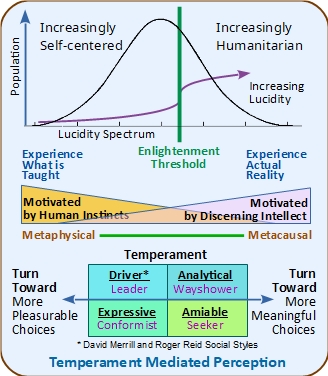
- A Testing Agent – This functional area is concerned with the examination of experience to develop understanding. In terms of Figure 1, this is Layer 4 – Comprehension. Temperament is an important characteristic of this layer.
- I use the point of view for the model of “spirit having a human experience.” That is a fundamental part of the spiritualist point of view.
- I define a person as an immortal self entangled with a human in an avatar relationship.
- During our human’s lifetime, our human is an avatar for our primary self.
- Layer 4 of Figure 1, Comprehension, is concerned with the third question of the Seeker’s Way:
- What is the nature of reality? (Layer 1)
- What is our nature? (Layer 2 and 3)
- What is our relationship with reality? (Layer 4)
- I use curiosity as the initial state of reality and understanding that satisfies curiosity as the expected final state.
- Our purpose is to gain understanding through experience.
- Progression is the degree to which we have gained understanding.
- In the conceptual space of the etheric, any question implies an understanding and a mechanism to gain that understanding.
- Our lot is to learn. Having learned, our lot is to teach. We are all seekers and teachers.
- The three ways of a teacher are:
- Imagination – Reveal the principles.
- Intention – Explain application of the principles.
- Attention – Demonstrate the effect of the application of the principles.