
Updated August 2026

Introduction
The Pragmatic Model of Reality treats reality as conceptual in that it is the realm of thoughts rather than things. The model is bound by curiosity as the initial state and understanding as the expected final state.
Imagine an undifferentiated field in conceptual space that has the single characteristic of a question. In this model, that question is described as curiosity about the nature of reality. That is the “big Bang” of this model. Rather than producing the physical universe, this conceptual Big Bang produces a dimensionless singularity that is conceptually infinitely large.
A question implies an answer and a means with which to acquire that answer. In this model, existence of those characteristics is organized by implied organizing principles. This is in the same sense that the physical Big Bang produced things and principles that organized those things. The implicate principles of this model are described in this paper.
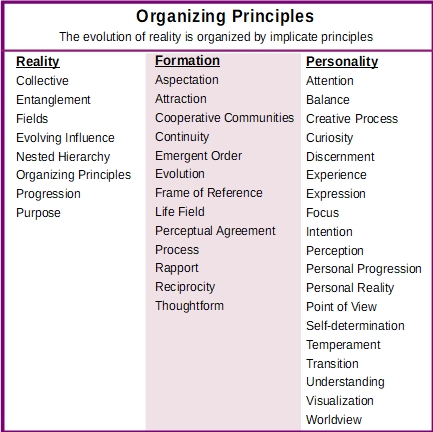
Link to Organizing Principles of Reality
Link to Organizing Principles of Formation
Link to Organizing Principles of Personality
Category 1: Organizing Principles of Reality
As First Cause, our reality field is a dimensionless singularity that is conceptually infinitely Large. These principles are concerned with the most fundamental characteristics of reality.
Collective
Sibling aspects of a common parent personality tend to cooperate as a collective to favor progression.
Entanglement
Entanglement
Purpose functions as an attractor to entangle life fields and thoughtforms.
Thoughtforms – A life field’s expression of an initial concept binds concepts with related characteristics as a cohesive gestalt-like thoughtform. Cohesiveness is a function of rapport. Concepts are expressed by life fields.
Life Fields – As the core element of a life field, personality binds functions as a binding influence
Aspectation – Child life fields inherit elements of their parent life field’s worldview.
Incarnation –Life Fields in a symbiont-avatar relationship share elements of their worldview.
Fields
Fields are a fundamental relationship of reality. Their structure includes an “attractor” concept that binds other concepts. Individual concepts may be bound in many fields. Entanglement is considered the binding principle. A common purpose defines the reason for entanglement.
Evolving Influence
Span of entanglement increases as life fields gain in understanding. Clarity of the thread of entanglement is described as lucidity.
Nested Hierarchy
A hierarchical relationship exists between Source, aspects of Source and subsequent expressions of those aspects. Child life fields inherit a subset of their parent life field’s worldview depending on their inherited purpose. Sibling life fields may have different worldview subsets while sharing the parent’s overarching purpose.
Organizing Principles
Reality operates according to implicate Principles that organize the expression of curiosity.
The expression of curiosity establishes understanding as the intended final state of reality. All else in reality are the fields (functions, processes and relationships) required to satisfy curiosity with understanding. Organizing Principles naturally emerge as influences to enable progression from curiosity to understanding.
Progression
A question implies the potential for understanding and a process by which understanding might be achieved. Progression is the degree to which understanding is achieved. The change in state from potential to realization.
Purpose
Purpose is modeled here as the urge to gain understanding that is shared by all life fields.
Category 2: Organizing Principles of Formation
Personality’s expression represents its imagined intended order. Formation of that intended order is bound by personality’s worldview and moderated by Organizing Principles of Reality (Category 1). Formation is concerned with the Creative Process. The following group of Organizing Principles addresses the nature of that process.
Aspectation
Life fields can express child life fields with the purpose of experiencing an imagined characteristic of reality. Expressed life fields inherit a subset of their parent’s worldview and purpose. Child-parent life field entanglement assures “return” of acquired understanding.
Attraction
The degree of perceptual agreement or rapport determines the extent of mutual attraction associating aspects of reality.
Cooperative Communities
Individual personalities collaborate with other personalities to form understanding. An effort to express understanding to others is necessary for progression. Collectives are inherently cooperative communities. A person is attracted to communities of like-minded people cooperating to facilitate progression.
Continuity
The reality field is the prime attractor for a nested hierarchy of expressed personal realities. Personal realities are bound by and inherit characteristics of the greater reality.
Emergent Order
Elements of a field tend to self-organize within the bounds of their inherited aspects of reality and according to Organizing Principles.
Evolution
The expression of intended order is bound by worldview while changing toward greater understanding. Consistent with the nested hierarchy architecture, change tends to be by way of “punctuated gradualism.”
Frame of Reference
An evolved hierarchy of meaning that defines a personality’s perception of reality. A collective worldview.The physical universe is a frame of reference, as is a person’s hometown.
Life Field
A thoughtform that functions as the mechanism by which curiosity is satisfied with understanding by way of experience. Personality represents a Life Field’s core function. It inherits purpose and collective understanding via entanglement with its parent life field. As the Observer, it binds the Judge or assessment function and Experiencer function of the life field. (Often referred to as personality or self.)
Perceptual Agreement
Personality must be in perceptual agreement with the aspect of reality with which it will associate.
The Creative Process, defined as “Changes in reality are expressed via personality’s attention on an imagined outcome with the intention to make it so,” is moderated by the Principle of Perceptual Agreement. The effect is that a life field can only experience or create what it is able to imagine. What can be imagined is limited by our worldview.
Process
Reality is modified by way of ordered sequences of events.
Rapport
Personalities are interconnected by links of shared attention and intention forming a matrix of relationships as a cooperative community.
One personality’s awareness of another personality manifests a link of influence between the two life fields, that is related to attention and intention. The nature of this link of rapport depends on the clarity (intensity) of awareness and the reason for the awareness. These links are dynamic and are thought to facilitate cooperation.
A life field’s attention on a thoughtform or other life field that is purposeful and informed by memory. Intentional influence exerted by a rapport network within a community of interest is thought to be cumulative with the potential of changing the community’s frame of reference.
Reciprocity
As personality influences reality, reality reflects that influence back to personality.
Thoughtforms
A thoughtform is a life field’s expression of an initial concept in a rapport network (nested hierarchy) that binds related concepts as a cohesive gestalt-like thoughtform.A life field expresses thoughtforms as experiencing agents (life fields) or meaningful thoughts. Thoughtforms are sensed by other life fields which in some cases may modify their meaning.
Category 3: Organizing Principles of Personality
Life fields express Experiencer and Information thoughtforms to acquired understanding through experiences. These are the principles thought to moderate the behavior of life field’s expression.
Attention
The steering influence in the Creative Process.
Balance
The natural order is the middle way in which actions are in agreement with Organizing Principles.
Creative Process
Changes in reality are expressed via personality’s attention on an imagined outcome with the intention to make it so.
Curiosity
First Cause – The initial state of reality is modeled as Curiosity in the Pragmatic Model of Reality. The expression of curiosity produces the potential for understanding.
Life Field – Curiosity is the source of attention which motivates the formation of expression and perception based on worldview.
Discernment
Finding understanding in experience implies the examination of the implications of potential understanding.
Experience
Personality inherits the urge to seek experiences which might lead to understanding the nature of reality.
Expression
Reality is expressed via personality’s attention on an imagined outcome with the intention of making it so. The imagined outcome is a mostly unconscious function of personality’s Worldview.
Focus
The ability to manage expression is, in part, a function of how well conscious self is able to focus the expression of intention.
Intention
Intention is the motive influence of expression.
Perception
Personality’s conscious awareness is based on its mostly unconscious, preconscious expression.
Personal Progression
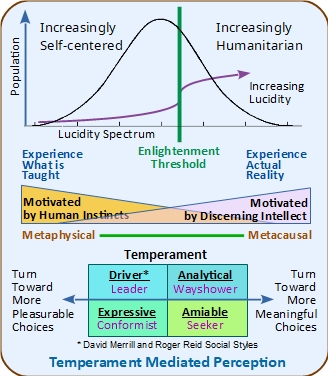
As illustrated in the Temperament Mediated Perception Diagram below, left-to-right movement along the Lucidity Spectrum represents a person’s personal progression toward greater lucidity.
Personal Reality
Reality is bound for a life field by the limits of experience represented by its worldview.
Point of View
A person’s assumption about the nature of reality that biases the person’s worldview and perception of truth.
Self-Determination
Personality’s behavior is limited by the Organizing Principles and moderated by Worldview and the collective.
Temperament
Experience is gained in cycles which are delineated by periods of transition to a new frame of reference.
Transition
Experience is gained in cycles which are delineated by periods of transition a different venue for experience.
Understanding
Perception of reality as it is and not as it is believed to be, with an emphasis on underlying principles. Understanding is relative and is thought to be a quality of worldview that converges on perception of the actual nature of reality.
Visualization
An imagining of the nature of reality derived from worldview. Expression is based on the intention to express an aspect of reality based on informed visualization.
Worldview
Worldview is a functional area of mind in the Attention Complex that represents a person’s current understanding about the nature of reality. An information thoughtform of learned responses moderated by understanding that is bound to the life field. It functions as a database populated with frame of reference, memory and acquired understanding as they are moderated by temperament. For a person (incarnate personality), worldview includes morphogenic instincts of the avatar and cultural influences as moderated by temperament.