
Recognizing and countering deceptive or biased information
Opinion 21

Brief
We are guided by two minds. One is our human’s instinctual urge to belong and to accept leadership. That is an evolved trait that serves to maximize the continuity even dominance of our gene pool. Our second mind is our spirit self that seeks to gain understanding through experience made possible by our human avatar. To find that understanding, it is necessary for us to recognize the actual nature of our experiences, thoughts and choices.
This paper includes a brief discussion of presumably neutral but often biased information sources that are intended to guide how we perceive our world. It is intended that readers will be able to develop greater discernment by recognizing harmfully biased information. The technique recommended here—the Talisman—is to always examine the implications of beliefs and choices.
Focus on
Capitalism at the Expense of Human Rights
Belief-based Governance
Self-centered Citizens
Community-centered Citizens
Steering the Ship of State (The Heritage Foundation)
Technology Augmented Propaganda
Fact Management
Artificial Intelligence
Wikipedia
Psi Encyclopedia
Parapsychology
Reddit
University Dojos
Algorithms
Excerpt from the Katha Upanishad
Societal Influences
Intentional or not, the public’s perception of truth is being molded into a worldview that is favorable to a ruling class. I discussed this in Studying Psi Phenomena in the Current Political Climate. In that paper, I identified five special interest communities that were seeking to control citizen’s beliefs:
Capitalism at the Expense of Human Rights
The effect of this shift in emphasis from the citizens and the community to corporations and religious authority has been blatant selective enforcement of the constitutional rule of law that favors the powerful over the average citizen.
Belief-based Governance
The focus here is on Christian Nationalism seeking to be a state religion. Some Evangelists and Christian Nationalists have increasing influence in American politics. Their influence has been shown in the harsh treatment of the rights of “others” aka citizens who are not white US Christians. This is especially concerning for those of us who study consciousness and Psi functioning. These religions tend to think we are associating ourselves with demons.
Self-centered Citizens
While the urge to have unbridled Capitalism or a state religion is a predictable response to human instincts, the willingness of some people to sacrifice the wellbeing of society for their personal gain is not as easily understood. A large part of our citizenry has been voting to support a conservative government despite the government’s openly declared intention to suppress citizen’s rights.
Community-centered Citizens
The nation is almost evenly divided between people who are relatively self-centered and people who are more community focused. Community-centered people tend to be more humanistic and less aggressive in promoting their point of view. They often tend toward greater discernment concerning cultural influences. They disadvantage themselves by their reluctance to assert citizen’s rights.
Steering the Ship of State
It is important to note that the conservative point of view is a blend of religious and capitalistic influences. Organizations have been formed to find ways to make the conservative point of view the national policy. The most influential conservative group has been The Heritage Foundation.
Technology Augmented Propaganda
A new approach to controlling public opinion is emerging in commonly used Internet search tools, social media platforms and online encyclopedias. For instance, it is in the best interest of a ruling class to keep citizens as illiterate as possible to dilute effective opposition. Capitalism tends to depend on relatively illiterate, perhaps gullible consumers to assure profits. The Internet has become a click generating tool designed to guide consumer buying. Information sources on the Internet such as news and public websites are often designed to steer visitors toward a specific purchase or ideology.
This dedication to protecting the current Physicalist paradigm or an ideology tends to manifest as dominant groups of zealous, radicalized participants in public forums intent on suppressing contradicting points of view. Ultimately, technology augmented propaganda is all about shaping the citizen’s perception of information.
Seekers can learn to navigate these information outlets without submitting to undue influences. Here are a few of the sources of information about which I have learned to be extra discerning.
Fact Management
Internet search tools have become an important way to find websites that might provide information we seek. My default search tool is Google. It has evolved over the years and has become more a dictionary/encyclopedia than a tool for finding websites. That is because the top of the first page of a typical search result is usually occupied by an explanation for the search term that is generated by Artificial Intelligent (AI). That is typically followed by Q&A snippets from discussion pages such as Reddit.com.
The major parts of the explanation usually include a reference link. References for some mainstream subjects link to reliable websites. For instance, information about David Chalmers includes a link to a paper on Philarchive published by the Centre for Digital Philosophy at Western University. While the offered link should lead to useful further reading, it is predictable that few people look beyond the AI explanation.
As noted below, the AI explanation is typically sourced from Wikipedia. If you ask Google Search tool “How much Google depends on Wikipedia for AI” the first part of the response is “Google depends heavily on Wikipedia as a foundational pillar for its AI ecosystems, using it both to train its core models and to ground real-time factual results.” The AI explains why by citing such qualities as “The Cleanest Text on the Web” and “Wikipedia as a primary source of truth.”
Artificial Intelligence
Artificial Intelligence (AI) is being trained using existing information such as websites and books. It appears AI is necessarily a backward looking (historical) information aggregator. It also appears to be trained with primarily mainstream material. For instance, there are thousands of essays, books and science reports written from a Physicalist point of view explaining mind while relatively few such reports support the nonphysical view. AI models will predictably emphasize the larger data source.
The fact that I am not certain about how AI is trained is, in itself, a warning that AI is an uncertain source of information. It is easy to ask AI what something means but if you do not already know the answer, it may be difficult to know if AI is hallucinating.
Seeker’s do well to know the implications of the fact that Wikipedia and social media are relatively easy sources for harvest material to teach AI. In this case it is clear that AI developers are not concerned with the quality of what they are teaching their tool.
Wikipedia
Take a moment and do a search for “parapsychology” on your favorite search tool. On Google, I am presented with an AI description at the top of the first result page. Each point in the AI description includes a link to further reading. Wikipedia is most often the source.
The AI description includes such terms as “alleged” and “mainstream scientists consider it a pseudoscience due to lack of reproducible evidence.” That directly echoes the opening paragraph in Wikipedia for “Parapsychology.”
Now take a look at List of topics characterized as pseudoscience on Wikipedia. While many subjects on the list may be poorly studied or poorly understood human experiences, some of those on the list are well studied and well understood, including parapsychological phenomena. All of the provided references supporting inclusion of a subject on the list appear to be from hardcore skeptics.
I endured a few years as a Wikipedia editor and can testify to the dominance of ultra-conservative editors. They have established rules that enable them to work together to subtly bias articles to discredit subjects that do not support their Physicalist views. For instance, I was permanently banned from editing the Rupert Sheldrake article that opens today with:
“Alfred Rupert Sheldrake (born 28 June 1942) is an English author and parapsychology researcher. He proposed the concept of morphic resonance, a conjecture that lacks mainstream acceptance and has been widely criticized as pseudoscience. …”
If you hover over the references, you will see that all are for hardcore Skeptic papers. I was banned because I was trying to bring a little balance to the introduction. The claim was that I was “illegally” promoting Pseudoscience.
Wikipedia may be okay for sports scores and such. However, based on my experience as a Wikipedia editor, I argue that anyone using Wikipedia as a reference is unwittingly consuming mainstream propaganda.
The bottom line is that Wikipedia is a powerful tool for perpetuating the current Physicalist paradigm by only presenting what has been and actively suppressing what might be future science.
More on Wikipedia below.
Psi Encyclopedia
Editors of the British Society for Psychical Research (SPR) Facebook page posted a link to the SPR Psi Encyclopedia article about Susan Gerbic. Although I can attest that Skeptic Wikipedia editors routinely participated in edit wars long before, Gerbic is credited with originating Wikipedia Guerrilla Skepticism in 2010.
As of this writing, 24 readers “Liked” the posting. I gave it an “Angry” emoji and commented:
This would be an excellent opportunity for organized parapsychologists to get a backbone and describe her [Gerbic’s] work as it is. Her minions violate virtually all of the Wikipedia rules of etiquette. “Right” amongst Wikipedia editors is the opinion that has the most aggressive and zealous editors.
For instance, I was broadly condemned by other editors for editing the EVP page because of my association with the ATransC. While I can edit there, doing so almost instantly attracts a handful of skeptic editors who revert anything I change. The rule they claim is Conflict of Interest or COI.
Since Wikipedia is a community edited encyclopedia, and remembering that numbers make authority in it, I tried very hard to attract people in our community to help edit. I know of at least one academic parapsychologist who also tried to attract help. As far as I can tell, none answered the call.
The parapsychological organizations are so focused on gaining credibility. Credibility does not start with the Ivory Towers. It starts on the streets.
I have to admit that I am insulted that the SPR has elevated a person who has done so much to harm our opportunities to understand Psi. She and her followers have never been bothered with facts, only clever biases. Being “academic” with her will only certify her authority. See Concerns with Wikipedia
Other comments and the number of “Likes” on the SPR post spurred me to add:
Okay, let’s take a closer look
What Gerbic calls “Guerrilla Skepticism” has been part of Wikipedia long before she names it. I was part of the process trying to keep a few of the arbitration cases from going “anti-new thought.” The outcome of the Fringe Science (2009) arbitration gave editors permission to discount publications that are not mainstream. That means they can delete references based on parapsychological publications if they do not support the Skeptic’s point. [I should have added that none of the SPR publications are acceptable as references … unless an editor from the dominant group of editors use it against us. That often happens.]
The Pseudoscience (2009) arbitration gave editors permission to name and delete anything deemed “Pseudoscience.” I was banned from editing the Rupert Sheldrake article for advocating a more balanced description of him and his work. They said I was promoting Pseudoscience. See their List of topics characterized as pseudoscience.
The Paranormal (2007) arbitration gave skeptic editors a tool to discount anything they claim is not mainstream science.
The top of the first page on a Google search for “Parapsychology” has an AI brief that is almost verbatim from Wikipedia. Google usually provides reference links. In this case, it used the Wikipedia Parapsychology page.
The Wikipedia Parapsychology article begins with a picture that implies fraud while saying “purportedly.” Using innuendo to seem professionally honest while implying doubt is a staple of Wiki editors. Words like “alleged” and “claims” are used throughout. The opening, summary paragraph ends with “…Criticized as being a pseudoscience, the majority of mainstream scientists reject it.[2][3][4] Parapsychology has been criticized for continuing investigation despite being unable to provide reproducible evidence for the existence of any psychic phenomena after more than a century of research [1][5][6].”
References [1] through [6] are mainstream, anti-new thought publications.
The top of the page has tabs that help the reader know how stable the article is from edits. Clicking on “View History” tab will show that there is currently a small edit war with a new editor trying to insert information about the viability of research results. That means the article is changing and using it for a reference is risky.
Now go to the “Talk” tab. You can see what the edit war is all about by reading the bottom discussion under “Non-neutrality of article.” It appears to be all about Jessica Utts and the use of statistics in parapsychology.
Note that after Wikipedia, the most commonly used source for Google’s search results is Reddit.com. That is another forum that supports a sort of “Lord of the Flies” editing atmosphere in which pseudonym editors can say and do what they want. I know that the material in the r/Metaphysics and r/Consciousness groups is decidedly mainstream. Much of it is written by decidedly “shade tree” advocates of philosophy. I have had my comments deleted several times.
Putting the Gerbic article in the Psi Encyclopedia is a little like submission in advance. As with so many other supposedly well-meaning articles like Braude’s “Felix Experimental Group,” it serves only the Skeptics. It is as if we are handing them our sword with which to slay us.
It is my personal policy to assume anyone who uses Wikipedia as a reference has no credibility and should be ignored.
Parapsychology
Not all of the articles in SPR’s online encyclopedia are supportive of furthering our understanding of Psi. In fact, everything about parapsychology in general should be carefully examined to understand the underlying message. This was made clear to me in a later exchange on the SPR Facebook Page.
Public Parapsychology posted a “Call for papers” for their “Psi in Practice Event Series.” From their website:
While focusing on four essential components of the scientific method—Observation, Prediction, Investigation, and Publication—we invite dialogue with practitioners, clinicians, scientists, scholars, experiencers, and members of the public. Along the way, we’ll consider Eastern philosophies, Indigenous methodologies, and other rich traditions that may expand current methodological practice while emphasizing reciprocity, responsibility, and respect.
The SPR Facebook page managers posted a notification about the series, about which a parapsychologist commented: “We have a whole unit at California Institute for Human Science on ‘Practical Applications of Psi’ which is running now.”
I took a look at the CIHS website and then replied on Facebook: “Perhaps you miss the point. The California Institute for Human Science appears to be focused on advanced degrees in Holistic Studies. That seems rather removed from “Practical Applications of Psi.”
He responded: “We have psychology degrees and clinical training (Doctor of Clinical Psychology). These also come with parapsychology concentration routes. I’m not involved in any holistic studies there, as the co-director of parapsychology education. No point has been missed at all.”
At first, I left the discussion, hoping to avoid an argument (again) with the parapsychologist. But the exchange bothered me, especially in view of this article about deceptive material on the Internet I am writing. I returned and posted:
This seems like a good time to sort out my understanding of the meaning of “Psi.”
From the PA web page: “The Parapsychological Association is … engaged in the study of Psi (or ‘psychic’) experiences, such as telepathy, clairvoyance, psychokinesis, psychic healing, and precognition.”
From the California Institute for Human Science web page: “CIHS … integrates mind, body, and spirit in higher education through research-informed programs in Psychology, Integral Health, and Integral Noetic Sciences.”
On the CIHS website, I saw a mention of parapsychology but without further information. The one place I found “Psi,” it was included in the usual list of considered phenomena in the “noetic” part.
CIHS is clearly focused on Exceptional Experiences Psychology and Anomalistic Psychology. Both treat Psi as a mental experience more related to mentation than to possible Psi field phenomena. In terms of parapsychology, that would be mental aberration or Super-Psi but probably not nonlocal mind.
The Public Parapsychology list of invited topics pretty clearly address Psi phenomena. For instance: “Theory formation and theories of psi” under the “Prediction” category and “Methods for stimulating psi in investigative contexts” under “Investigation.” These appear to support nonlocal mind theory.
Here is where I may be confused. “Psi” is commonly used to address the external influence of thought. It is useful to think of it as mind’s “internal” mentation (thought) and mind’s external expression (Psi). First Sight Theory divides this as two assumptions (outward – 1.) mind senses psychically and 2.) expresses psychokinetically), followed with a series of corollaries addressing mentation. ethericstudies.org/first-sight-theory/
Anomalous Psychology is specifically mentation … it does not allow Psi. Exceptional Experiences Psychology is basically Anomalous Psychology but allows for Psi so long as it is treated as an emergent quality of biological mind.
Am I misunderstanding the meaning and intent of Psi?
There was no response. I am learning that Facebook is not a good place to debate.
Need for science – Rationally applying the scientific method to consciousness and Psi studies is essential. The paranormal community is something of a “Tower of Babble” and the orderly approach of science is likely the only way we can bring order to the Seeker’s three questions (below).
As I understand the history, psychologists and philosophers were the ones who helped introduce a more scientific study of unusual human experiences and capabilities. At least in this modern time. In my view, the Hermetic and Upanishad ancient wisdom teaching appear more explanatory. The difference is that psychologists tend to assume mind is an emergent quality of brain. The ancient teachers clearly understood that mind and brain are very different.
Today, parapsychology is still under the authority of psychology. The dominant point of view is Anomalistic Psychology which holds that mind is absolutely the product of biological brain (locality, local mind meaning in the brain). A more liberal point of view dominating parapsychology is Exceptional Experiences Psychology. That school of thought agrees with Anomalistic Psychology but allows for the nonlocality of some aspects of mind. That is, Psi is an emergent quality of brain-based mind, but Psi is not evidence of nonlocal mind.
From my experience, university-based parapsychology groups are dominated by Anomalistic or Exceptional Experiences Psychologists. They are very good at making their study apply to all forms of Psi, but if you read with a discerning eye, you will see that most academic explanations for such experiences as mediumship and remote viewing are biased toward some form of mental aberration.
While I continue to engage with parapsychology where I can, I am mostly a critic these days. My hope is that the needed research will eventually evolve from “parapsychology” to something like “consciousness and Psi Studies.” That, without the dogma of academic Physicalism.
It is up to you if this is to happen.
I recently began spending time on Reddit.com hoping to find like-minded consciousness and Psi thinkers. I have focused on the r/consciousness, r/Metaphysics and r/analyticidealism groups. Beyond the predictable inane chatter, what I have found is mostly academics who insist on the Physicalist view.
Like Wikipedia, Reddit discourages the use of real names, so it is mostly impossible to know the qualifications of the people. However, it has become obvious that the groups are dominated by moderators who are academics. Some of the moderators delete posts that do not agree with their Physicalist or historical view.
On the Google search page for parapsychology, scroll down to the “People Also Ask” section that follows. Many of the comments are on Reddit. Most are negative to Psi studies and parapsychology. Like Wikipedia references, Reddit serves as a way to subtly cast parapsychology in a negative light. Very little actual information about parapsychology is included in the top part of the search results.
University Dojos
Wikipedia editors are expected to provide sources for all fact statements. As I described above, reference numbers in the text include a link to the list of references at the bottom of the page. There, the reader can see the source. Examining the references can help readers understand the editors point of view. One thing to look for is how editors sometimes selectively emphasize negative parts of an otherwise neutral to cast a more negative light on the subject.
Editors often appeal to academic authority for support of their edit. A seemingly neutral reference may solidly support an edit intended to make something like parapsychology appear to be nonsense. As such, it is important for readers to understand that academia is not neutral but tends to follow schools of thought.
Academically trained thinkers often identify with the school of thought taught by their professor. In turn, professors are typically hired because they agree with the school’s point of view. References used by editors may be for solid, credible academic sources that are Physicalists to their core.
As a general statement, Near-Death and Out of Body Experiences are typical of the kind of exceptional human experience studied by universities. I have noted that university departments studying human potential follow the Anomalistic Psychology approach that assumes apparent phenomenal experiences are normal mistaken as paranormal. They are very good at writing reports that seem like good science, but that subtly argue against the paranormality of possible Psi experiences.
Observers can sometimes see a professor-student relationship that is similar to martial arts master(teacher)-student relationship in dojos.
Algorithms
Social media such as Facebook clearly uses algorithms designed to show readers what they want to see and what sponsors want them to see. Click on a conservative-leaning political post and an algorithm will feed many more with the same sort of message to your page.
AI also appears to be using algorithms. I do not know the current measure for which web pages are shown first. My focus is on the references and source material used in the “AI Overview” and “People Also Ask” sections typically at the top of the first results page of a Google search. The provided references are too often from Reddit and Wikipedia.
Algorithms tend to reinforce information siloes in society. My Facebook feed is full of archaeology, science and liberal political articles because I have previously shown an interest in those. It would be easy for me to think that there are only mean-spirited, stupid conservatives because I only see complaints about them. Some are … just as some liberals are. It is up to me to realize that most are not. That is why I spend a lot of time on other news services such as Ground News.
Discernment
The freely available information on the Internet does not come to us without a price. This paper is free to you, however, there is a cost. My primary purpose in writing this paper is to convince you to be aware of the need to protect yourself from manipulation by your government and special interest groups.
I want you to learn to question the implications of everything you experience … especially what you are told.
Excerpt from the Katha Upanishad
One of my favorite lessons about our spirit nature comes from the ancient Hindu Vedic Sanskrit text called the Katha Upanishad. The over 200 Upanishads describe the nature of ultimate reality and the path to gain spiritual maturity. They are thought to have been written 3,000-to-4,000 years ago and are based on oral tradition about truths given to seekers by the gods.
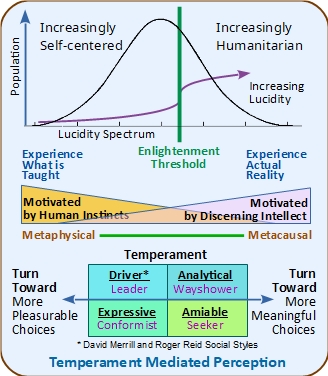
The Temperament Moderated Perception Diagram illustrates the range of deciding between choices based entirely on human instincts and cultural norms on the left and choices made with increasing discerning intellect on the right. In the Katha Upanishad, that range can be reworded as Pleasurable on the left and “Preferable” (aka Meaningful on the right. From the Katha Upanishad: (Vedanta Spiritual Library. shastras.com/upanishads-krishna-yajur-veda/katha-upanishad/)
1-II-1. Different is (that which is) preferable; and different, indeed, is the pleasurable. These two, serving different purposes, blind man. Good accrues to him who, of these two, chooses the preferable. He who chooses the pleasurable falls from the goal.
1-II-2. The preferable and the pleasurable approach man. The intelligent one examines both and separates them. Yea, the intelligent one prefers the preferable to the pleasurable, (whereas) the ignorant one selects the pleasurable for the sake of yoga (attainment of that which is not already possessed) and kshema (the preservation of that which is already in possession).
Seekers learns to suspend judgement for a moment to allow time to discern between understanding information from the perspective that serves their human (pleasureful) and understanding that serves their spirit self (meaningful).
The key concept here is learning to have discernment. That is described in line I-III-7 below:
1-III-3. Know the Self to be the master of the chariot, and the body to be the chariot. Know the intellect to be the charioteer, and the mind to be the reins.
1-III-4. The senses they speak of as the horses; the objects within their view, the way. When the Self is yoked with the mind and the senses, the wise call It the enjoyer.
1-III-5. But whoso is devoid of discrimination and is possessed of a mind ever uncollected – his senses are uncontrollable like the vicious horses of a driver.
1-III-6. But whoso is discriminative and possessed of a mind ever collected – his senses are controllable like the good horses of a driver.
1-III-7. But whoso is devoid of a discriminating intellect, possessed of an unrestrained mind and is ever impure, does not attain that goal, but goes to samsara. (Note 1)
1-III-8. But whoso is possessed of a discriminating intellect and a restrained mind, and is ever pure, attains that goal from which he is not born again.
1-III-9. But the man who has a discriminating intellect as his driver, and a controlled-mind as the reins, reaches the end of the path – that supreme state of Vishnu. (Note 2)
Notes
-
-
- Samsara is Hindu for the cycle of death and rebirth as life is bound to the material world.
- Supreme state of Vishnu refers to self-realization or self-knowledge.
-
The Seeker’s Talisman
A Seeker is a person who recognizes there is a difference between perception of reality and the actual nature of reality, and who seeks to align his or her worldview with that actual nature of reality. Think of the Seeker’s three questions as a way to model this:
- What is my nature
- What is the nature of reality
- What is my relationship with reality?
The various forms of social engineering discussed above will always work on us if we do not learn to examine the implications of what we are told. Our mind’s worldview is conditioned to accept what we are told, so by questioning the implications of what we think, our conclusions and choices, we gradually retrain our worldview to better align with the actual.
And so, the Seeker’s Talisman is the habitual examination of implications of our truths.