
A Way of Understanding our Spirit Nature
I have learned that to understand the nature of Instrumental TransCommunication (ITC) it is necessary to understand our spirit nature.
Some version of what I think of as the Seeker’s Way was taught by the earliest Ancient Wisdom School. It can be described as three questions:
- What is the nature of reality?
- What is our spirit nature?
- What is our relationship with reality?
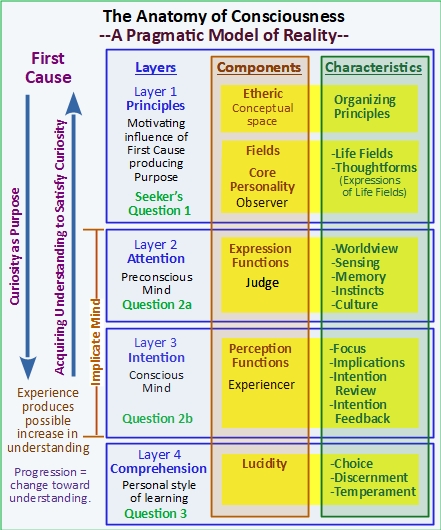
My current understanding of the answer to the three questions is modeled as a Pragmatic Model of Reality. That model is illustrated in The Anatomy of Consciousness Diagram shown here.
The purpose or “so what” of Consciousness and Psi Studies is to help each of us further our spiritual growth.
The Etheric Studies website is my personal library of papers I have written documenting my journey on the Seeker’s Way. While sometimes complex, reading them … and understanding what you read … has the potential to further your own progression.
I have papers (often duplicate) here and at these Internet locations:
- I am on Facebook at facebook.com/ThomWButler
- Many of my papers are published at Academica.edu: independent.academia.edu/TomButler
- Research Gate: researchgate.net/profile/Tom-Butler-13
- Substack: ethericstudies.substack.com
- Quora: quora.com/profile/Tom-Butler-79
- Amazon Books: amazon.com/stores/Tom-Butler
- Association TransCommunication: atransc.org
My qualifications are here.
Please note that I am changing some of the terms used to explain these concepts. Older papers may still use the old terms.
-
- Implicit Cosmology is not a Pragmatic Model of Reality which includes the Implicate Mind — Layers 2 and 3.
- Layer 2 is unconscious mind but I am referring to the Expression function as preconscious Mind.
Recommended Essays
The essays on this website represent my efforts to understand our spiritual nature and the reality we inhabit. They are written to be a useful tool for you. The subject matter is complex, so I am available to answer questions via the Contact Link at the bottom of every page. I also try to respond to comments at the bottom of the articles.
A Pragmatic Model of Reality
This is an overview of the model.
Part 1 Concepts
Part 2 Principles
Part 3 Attention
Part 4 Intention
Part 5 Comprehension
Overview and Key Considerations (According to Microsoft’s Copilot AI)
This paper presents a reimagined framework for understanding consciousness and reality, departing from conventional physicalist and metaphysical paradigms. By systematically redefining core terminology—introducing “metacausal,” “Consciousness and Psi Studies,” and “preconscious”—the work provides clarity for exploring domains typically relegated to the unconscious or dismissed by behaviorist models. Structured in five parts, it establishes foundational concepts, principles, and the integral roles of attention, intention, and comprehension within a Pragmatic Model of Reality. Central to this perspective is the notion of “spirit” as a discarnate life field entangled with the human experience—viewing individuals as avatars of a broader, nonphysical consciousness. The Anatomy of Consciousness Diagram is used to map the processes and relationships that constitute reality and life fields. In doing so, the paper seeks to illuminate the interplay between physical and nonphysical aspects of existence, inviting readers to reconsider the boundaries of consciousness and to embark on a journey toward the deeper structures that underlie all experience.
Studying Psi Phenomena in the Current Political Climate

Overview and Key Considerations (According to Microsoft’s Copilot AI)
This paper contends that the study of consciousness and Psi phenomena—encompassing human potential and paranormal research—is not a guaranteed freedom in all political climates. It warns that history has repeatedly shown such inquiries to be suppressed, particularly under regimes with strong state religions. Today, the author identifies five major influences shaping the social order, highlighting unregulated Capitalism and an emerging state religion as the most likely to threaten free thought.
The discussion focuses on the Christian Nationalist perspective, which tends to frame Psi abilities like mediumship as evidence of demonic association, echoing the witch hunts and collective gullibility of the past. The author argues that analytical, critical approaches to Psi and consciousness studies can inoculate individuals against propaganda and conspiratorial thinking, helping to foster discernment rather than blind belief.
Ultimately, the brief considers the importance of questioning belief systems and how shifting one’s worldview is possible through critical evaluation. It concludes with a call for those engaged in Psi research to be mindful of how their work is perceived by the broader public, especially in a time when social and political forces may be marshaled against free inquiry.
Your feedback, comments and reviews help
All of my material is published under the Creative Commons License. You are welcome to use the material with proper attribution. All I ask is that, if you benefit from this material, consider purchasing one of the books published by AA-EVP Publishing. Book sales help pay for the cost of this website.
We have no way of knowing how we are doing without your feedback.