
Opinion 23

Brief
This paper provides a brief introduction to the anomalous features found in ITC examples. Emphasis is on the numerous, poorly formed faces often found in the medium density light areas of ITC examples. Studies of ITC indicate that the paranormal features and speech of ITC represent the expression of intended order acting on relatively indeterminate energy. The practitioner and/or interested observers are thought to function as a Psi-to-physical conduit. If reasonably correct, understanding the perception forming process—sensed information > consideration > expression > perception > and intention feedback to the consideration stage – may help us understand the origin of the faces. A discussion about the formation of expression and perception is followed by a summary of implications. The point made here is that formation of ITC examples is colored by practitioner and observer expectations.
Psi Phenomena as a Window on our Mind
Psi phenomena such as audio and visual forms of Instrumental TransCommunication (ITC), (1) provide a way to study the nature of mind and the greater reality. ITC is an especially useful research tool because examples of Psi functioning can be induced by competent practitioners. To develop a model for ITC, it is necessary to consider the nonphysical-to-physical interface, the effect of intention on physical processes and how the formation of examples might be colored by practitioner and observer expectations. My study of Psi phenomena (2) has resulted in a Pragmatic Model of Reality. (3) intended to describe mind (mentation) and Psi phenomena in general.
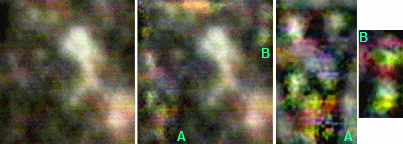
Studies have indicated that instances of transform Electronic Voice Phenomena (EVP) are formed by the Psi expression of intended order acting on relatively indeterminate (dirty) audio energy. (4) The same can be said for the apparently paranormal features sometimes found in medium-density light-dark optical noise. (5) Note the example below. I will address the apparent smaller faces later in this paper.
A feature was found in a video-loop ITC session that appeared to be an image of a cow. Shown here is a small part of a standard video frame. The cow feature is unenhanced in the left frame. Next is an enhanced version of the same image. Note the smaller face-like features lower-left and upper-right of the cow. Those features are shown further enhanced in the next two frames. It is common in this technique to have soft, often blurred features due to the relatively low resolution of the devices.
While it is common to find transform ITC that has been formed in electronic devices, light reflecting from surfaces such as television screens sometimes produces optical noise capable of supporting ITC, as well. See the Mr. D example below.
The Faces on Turned Off TV phenomenon is different from the usual transform phenomena and is not addressed here. (6) You can see an example on the June 25, 2026, Faces on Turned Off Television Screens Substack post. (7)
We published an example of light reflected from a turned off TV screen ITC in the Summer 2006 AA-EVP Newsletter (8) titled “A Portal to Another Physical World?” The abbreviated article is below.
A Portal to Another Physical World?
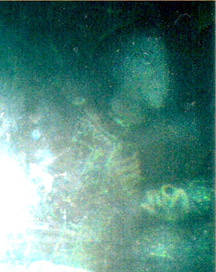
We have received reports of phenomena that might be best explained as evidence of a portal between this physical reality and something else that is not necessarily nonphysical. Part of the report was an example of a face in light reflecting from a turned off television screen. Unlike the usual example in which there is a child in the scene, and the face is peering into the room from “inside” of a TV, this one seems to be a portrait of a military man that is formed in the optical noise reflecting from the screen surface.
We will refer to the experiencer as “Mr. D” to respect his privacy. The first picture is a cropped version of what he sent us that only shows the turned off rear projection TV screen. Mr. D was taking a picture of his pet, and the rather large screen was incidental to the picture. As you can see, the feature is formed in the noise from the flash. Contrast and brightness have been slightly modified to clarify the feature.
To us, the picture appears to be of a man sitting on an easy chair or couch with his left hand on the left armrest. Based on his posture, his left leg would be turned nearly against the chair, knee nearly under the arm rest. He is wearing a dark red jacket that has piping around the buttons and collar. The jacket has a high, stiff collar that is close to the throat. He apparently has short dark hair and is facing to his left (your right). His face is tilted slightly up. His left hand resting on the armrest has six fingers that are more like tentacles than bony. Alternatively, it may be that he has a very large ring on his index finger. He is holding something close to his chest. It may be the neck of a guitar, or it is his right hand. If it is his right hand, he has six fingers.
It is important to note that Mr. D reported that there was a period of time in which he experienced quite a lot of activity, including orbs that would seem to come out of a wall, move about, even stand still at times and then pass out of sight through another wall. He sent us a couple of videotaped examples, including one that shows his dog leaping from the couch just before an orb swooped down from above, apparently intent on harassing the dog. Mr. D told us the dog and orbs seemed to be playing.
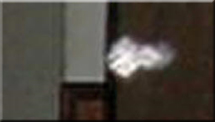
From Mr. D’s comments: “The orbs I have seen all have common traits. When not moving they look like plasma, they have a definite shape, and the inside of the orb has swirling white that looks electrical. They also have a tail of sorts. Some people call it a contrail, but it is not, because the ‘tail’ is there when the orb is stationary. The tail kind of swishes back and forth. It vibrates back and forth rapidly Just before an orb takes off at high speed.”
Mr. D also reported computer text files and a bright light in his basement. D also reported computer text files and a bright light in his basement.
Mr. D’s unusual activity has subsided except for the occasional event seemingly designed to let him know that there is still contact. A ghost hunting group has investigated Mr. D’s home, and via our communication with him, we are convinced that he has the experiences he reported. The orb video and picture are convincing, and the face on the TV screen is extraordinary. Where he lives is not very old and he could find no reports of events that would produce a local ghost or emotional energy. Read the article on Page 14 of the Summer 2006 AA-EVP NewsJournal. (8)
Mr. D’s reflected light ITC feature is unusual both in its scale and its detail. A useful model for other forms of ITC is that an incarnate or discarnate personality expresses an influence on chaotic physical noise to transform it into an intended order which we experience as the paranormal feature. Mr. D’s example fits the idea that medium density (balanced light and dark) chaotic energy caused by light reflected from the surface of the TV screen has been transformed into a reasonable simulation of a sitting man. The man’s identity, why and how he appeared on Mr. D’s TV screen are remaining questions.
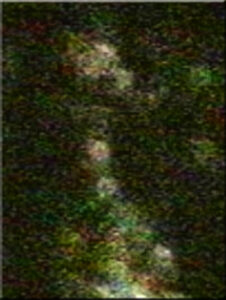
The small face-like featured in the Cow ITC example above may help answer the question. Below is another ITC example that includes many face-like features and one relatively clear human face. In fact, I have been using the full-featured man seen at the bottom of the picture as one of my avatars. As I see him, he is a slightly balding, man facing to your right ear. He has a full beard and is wearing a 16th century ruff around his neck.
Look closely at the circular, bubble-like areas filling the mid-density background. Each bubble appears to be a face. Most of the features have only one or two spots for their eyes, maybe a nose. Mostly what is visible is the lighter color of their round face and possibly an ear or tempo. As with the cow example above, we see numerous face-like features crowding the mid-density light areas of many of our ITC pictures. It is as if there is a background field of noise populated with faces.
Theory
The Pragmatic Model of Reality (3) has been composed to help us understand how the expression of intended order might produce the anomalous faces of ITC
Spirit having a human experience.
Reality is assumed here to be a dimensionless singularity that is conceptually infinitely large. That means objects in reality are conceptual thoughtforms. Thoughtforms may be experienced as physical objects depending on the intention of the expressing life field. The expressing life field shares much of its worldview with its collective of sibling life fields. The evolved worldview represents characteristics assigned to the expressed thoughtform such as physicality, color and meaning) that are “agreed to” by the collective.
The life field thoughtforms are modeled here as experiencing agents. They are sometimes referred to here as “personality” or “self.” In that context, a person is a personality entangled with a human avatar. Our human is also a life field, but one that has evolved in the physical aspect of reality. A biological organism is modeled as a nested hierarchy of life fields (cells) organized by a morphogenic field (a mind). (9) The primary self in the person relationship is the spirit aspect, but the dominant aspect is the human self.
A morphogenic mind is described in Rupert Sheldrake’s Hypothesis of Formative Causation (aka Morphic Resonance) as “Nature’s Habit.” (10) It functions as a parent life field for the collective of instances of that species. In that way, the evolution of the species paces the evolution of the physical aspect of reality.
Developing an expression signal
Take a look at the Life Field Diagram below. It is a model of the functions, processes and relationships of a life field.
The paper titled A Pragmatic Model of Reality (3) includes a detailed discussion of life fields. The objective of this paper is to discuss how the Pragmatic Model helps explain the faces found in examples of ITC. In this explanation, the term “signal” is used to describe a streaming Psi influence.
The signal flow is sensed information > consideration > expression > perception > and intention feedback to the consideration stage. Referring to the diagram:
Sensed information – Every life field expresses information in the form of a Psi signal. Sensed information represents Psi signals from other life fields. If incarnated, the person’s physical body also expresses sensory information.
Attention Limiter – A function that only allows relevant information into the Attention Complex.
Attention Complex (Consideration) – The functional part of a life field that considers sensed information, and based on worldview, develops an expression signal. This complex is the unconscious aspect of a mind.
Preconscious Psi Expression – The expression signal is a version of the related sensed information but modified to agree with the life form’s worldview. Rather than “this is what I sense,” it represents “this is what I think I have sensed.” It is considered “preconscious” because it is a signal from the unconscious mind that is always outwardly expressed as a Psi signal of which the conscious self may or may not become aware to form perception.
Conscious Perception – Following Proposition Two of First Sight Theory (below), life fields only become aware of sensed information after it has been considered and colored to produce an expression signal.
Intention Feedback – Perceived information is tested to determine if it is what the life field consciously intended or wants. The Lucidity Test represents the life field’s discerning intellect (lucidity). The life field’s agreement between what it perceives and what it wants forms a feedback signal representing what the life field intends. This feedback signal appears to only suggest but not directly change worldview and therefore expression. If the life field consciously agrees with its expression, the feedback will reinforce expression.
Making the world
As used here, a frame of reference can be thought of as a venue for experience. Think in terms of a hierarchy of frames such as home, town, county, world, universe. Characteristics of a frame of reference are shared as part of cooperating life field’s worldview. In terms of the physical aspect of reality, life fields with an interest in experiencing physical incarnation do so by integrating the related thoughtforms that define the physical point of view.
Think of a thoughtform as a Gestalt-like bundle of information (data packet or thoughtball). Compare a thoughtform to a novel. A well-written novel will leave the reader with a sense of personalities, places, moods, challenges … all of the information a reader needs to develop a sense of “being there.”
Thought is a streaming process. Compare that to a streaming video or a song playing (streaming) on a radio. I model thought as a thoughtform, but thoughtforms are more like streaming thought that fades from one central concept to another. Thought, especially the influence of thought, is referred to here as Psi or Psi functioning.
In the Life Field Diagram below, the Preconscious Psi Expression is a streaming, complex thoughtform that tells interested life fields what the originating life field thinks of its personal reality. Life fields cooperate in collectives and that expression thoughtform guides other life fields in the collective. In that sense, members of the collective agree on the nature of a local aspect of reality … the local frame of reference.
The streaming expression is a streaming intention signal based on the life field’s worldview. In effect, the life field senses information from the Psi Field, considers the information by passing it through a “I think this is true” modifying process and then expresses that modified version back into the environment.
As illustrated in the diagram, life fields can be expected to have a function that rejects (ignores) all but those thoughtforms that are interesting to the life field. For instance, after first feeling my chair, I soon ignore those associated bio-Psi signals. While they are still present in the Psi Field, the Attention Limiter allows me to ignore them.
Most sensed environmental Psi signals are the thoughts of other life fields. Keeping in mind that reality is modeled here as a dimensionless singularity (no physical distance). The other life fields may be experiencing a different frame of reference … maybe another galaxy, maybe an elephant’s skin cell.
It is important to note that the Attention Complex in the diagram represents our unconscious thought process. Sensed information that is passed by the Attention Limiter function initiates a consideration and transform process that results in a streaming expression signal that represents a version of the original information. That is, the life field’s outward thoughts are triggered by an incoming signal that represents what other life fields think is true about reality.
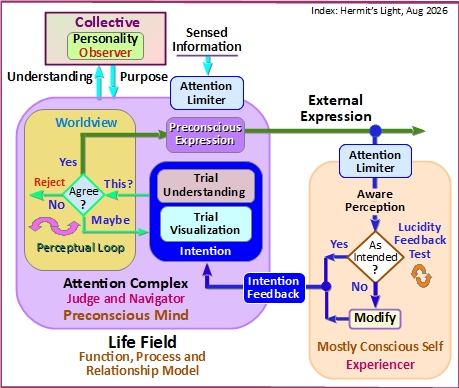
The Mostly Conscious Self part of the diagram represents the functions with which mind develops awareness of the expression story being told by its unconscious processing of sensed information. This part of our mind is considered mostly conscious, but it does include functions that are more reflexive than deliberate. For instance, if our preconscious expression is a fearful response to something, the Intention Feedback signal returned to the Perceptual Loop will be neutral (no change influence), reinforce the fear with positive feedback or reduce the fear with negative feedback depending on the outcome of the Lucidity Feedback Test.
Temperament (analytical or amiable for instance), lucidity (guided primarily by instincts versus guided by informed discerning intellect) and memory are the primary factors that decide the outcome of the Lucidity Feedback Test.
It is important to note that much of what mind expresses is ignored by the Conscious Self’s Attention Limiter. What is passed by the limiter is mostly what is expected. In that sense, there does appear to be some linkage between the Worldview function of the unconscious mind and the Lucidity Feedback Test.
First Sight Theory … a ruleset for the Attention Complex.
First Sight Theory was developed by James Carpenter (11) based on his work as a clinical psychologist and his study of Psi functioning practitioners, especially those working with remote viewing. He composed the theory to describe his understanding of how Psi function might work. It has proven useful in providing a rule set of sorts for the Life Field model I use here.
By rule set, I intend that the set of functions, processes and relationships implied by sentient life are organized in a way that allows the mind of life fields to produce expression and perception signals in response to sensed information.
A more comprehensive discussion of the theory is in the paper About First Sight Theory. (12) Note that James Carpenter described the theory in terms of psychic relationships and physical brain interfaces. My focus here is psychic sensing (Psi). I argue that our physical senses come to our mind as Psi signals.
First Sight Theory
Much of this is my paraphrase of the functions, processes and relationships theory proposed in First Sight: ESP and Parapsychology in Everyday Life by James Carpenter. (11)
Proposition One — People psychically sense environmental signals.
Proposition Two — People process this information unconsciously, and it is the conclusion of that processing that they are aware of and react to … only indirectly what has been psychically or physically sensed or unconsciously considered.
Therefore
The following corollaries address the perceptual process: (paraphrasing):
- Personalness Corollary: The unconscious processes that constitute consciousness are personal and deliberate.
- Ubiquity Corollary: (Part 1) Psi sensing is not limited by time or distance. See Note 1 below.
- Integration Corollary: Other preconscious processes are processed together with Psi in a rapid, holistic, efficient, unconscious manner to format experience and action.
- Anticipation Corollary: The mind seeks to anticipate events.
- Weighting and Signing Corollary: The importance of sensory and extrasensory information is weighted as being more or less important before it is acted upon.
- Summation Corollary: The content of conscious experience, emotional states and behavioral choices are constituted in a summative way by unconscious thought.
- Bidirectionality Corollary: In this summative process, the person may turn toward information (signed positively) to include it in the construction of experience, affect or action, or turn away from information (signed negatively) and exclude it.
- Intentionality Corollary: Including or excluding information is a function of unconscious intention in regard to an element of potential meaning.
- Switching Corollary: A person will be fairly consistent in how information is processed, (but) may switch in how information is weighted, the sign attributed to it, and therefore, whether or not it is included in behavior. This switching will occur rapidly or slowly depending on the consistency and purity (focus) of unconscious intention, and this, in turn, is determined by the relative weight of the information over time, situational factors that promote or diminish critical analysis, changes of approach in a task and mood.
Persons who are disposed to switch rapidly include those who:
-
- tend to approach situations cognitively and analytically
- lack consistent purpose and motivation
- take a detached-observer posture toward most situations
- are chronically ambivalent
- are cognitively disorganized are highly distractible
Persons who tend to switch slowly, conversely, tend to be persons who:
-
- approach situations globally and holistically
- are strongly and consistently purposive
- engage themselves wholeheartedly in situations
- are not overly self-doubting or uncertain
- are well-integrated cognitively
- are prone to hold focus purposively and not become distracted
- are dissociative (when in certain states).
- Extremity Corollary: The frequency of switching affects the relative density of accumulated additive or subtractive references to the meaning in question. Rapid switching renders potential meaning irrelevant to ongoing experience.
- Inadvertency and Frustration Corollary: Information gathered via Psi is not available to conscious experience but does contribute to the formation of conscious experience by the arousal of anticipatory networks of ideas and feelings (assuming that they are heavily weighted, afforded slow switching and approached with the intention of assimilation). Because of this arousal, their action can be glimpsed consciously only by observing thoughts, feelings and behaviors that are inadvertent; that is, not intentional and not obviously caused by any current experiences. Someone who has become skillful in interpreting them is thought of as relatively psychic.
- Liminality Corollary: The arousal of anticipatory networks of ideas and feelings resulting from unconscious Psi information may be considered liminal ones, in terms of the boundary between conscious and unconscious thought. Habitual interest in liminal experiences facilitates expression of Psi processes (openness), leading to unconscious reference to Psi material (and other streams of unconscious material). A more positive, open, secure state of mind will tend to facilitate reference to a broader spectrum of contextual, potentially liminal experience.
Note 1: There is a “Ubiquity Corollary Part 2: Psychokinesis contributes to the formation of experience by bringing intention to bear upon the physical processes of the nervous system.” I did not include it here because it seems to imply expression is only mind-to-body which does not consider mind-to-mind exchanges.
Mind as conduit for intended order
Our study indicates that the features of ITC are formed by the expression of intended order. This Psi influence can be from any mind anywhere. The only requirement is that the Life Field must be aware of the process. In the case of visual ITC, awareness of an ITC session typically includes the expectation that meaningful visual features will be found in the resulting recording.
Here is the speculation. Our life field is immersed in a Psi Field populated with other life fields. We sense them, and if we note their presence, when we are incarnate as humans, we visualize them as people based on their expressed sense of self. We visualize them as faces because we as self (spirit) entangled with a human think from the biological perspective of our human.
The result is that visual ITC examples seem to show the formation of face-like features in virtually every suitable field of light energy. It is as if there is a background noise composed of faces. The speculation presented here is that our expressed intended order is modulated by the influence of many incarnate and discarnate life fields which our incarnated mind interprets as people.
Visual ITC recordings typically have a primary feature and many secondary face-like features. Is it the practitioner’s or interested observer’s expression of intended order that is directly influenced by an intended communicator and indirectly influenced by our awareness of other life fields?
Implications
The Pragmatic Model of Reality (3) predicts that we are entangled with a human avatar and that our perception is greatly influenced by our human’s worldview. It also predicts that our expression is influenced by our awareness of other life fields.
Following the Pragmatic Model, not all of those life fields are incarnated. Also, when a person dies, its human life field appears to reintegrate with its morphogenic mind and the person’s self (spirit) life field is thought to merge with its collective.
I like to describe this reintegration with a choir analog. The choir represents the life field’s collective. When the life field incarnates, it is like a member of the choir stepping forth to sing a solo while it continues to be supported by the choir. Upon death of the avatar, the life field returns to the choir. Perhaps others step forth for their solo.
In this model, we never die. We continue to experience reality, either indirectly through the collective or directly through an incarnation. While members of a collective share worldview, individual life fields are distinguished by their temperament. While members of a collective share worldview, they may individually exhibit different degrees of lucidity. This possible individuality should be considered when assessing the implications of First Sight Theory and the Pragmatic Model of Reality.
A mental medium contacts a deceased loved one for a sitter by turning attention toward the sitter’s memory of the loved one. A competent medium will have developed the mental ability to focus his or her Attention Limiters so as to pay attention to the sitter’s loved one as identified by the sitter’s memory. The deceased loved one is not somewhere. Nonlocality means everywhere is here.
References
- Butler, Tom. “ATransC White Paper on Transcommunication.” Association TransCommunication. atransc.org/itc-white-paper/.
- Butler, Tom. “What ITC Tells us About Consciousness.” Etheric Studies. ethericstudies.org/what-itc-tells-us-about-consciousness/.
- Butler, Tom. “A Pragmatic Model of Reality.” Etheric Studies. ethericstudies.org/pmr/.
- Butler, Tom. “Locating EVP Formation and Detecting False Positives.” Association TransCommunication. atransc.org/locating-false-positives/.
- Butler, Tom. “Video-Loop, Visual ITC Recording Technique.” Association TransCommunication. atransc.org/video-loop-visual-itc-recording-technique/.
- Butler, Tom and Lisa. “Faces on Turned Off Television Screens.” Association TransCommunication. atransc.org/itc-faces-on-turned-off-tv/.
- Butler, Tom. “Faces on Turned Off Television Screens.” Etheric Studies Substack. ethericstudies.substack.com/p/faces-on-turned-off-television-screens.
- Butler, Tom and Lisa. “ATransC NewsJournal Archive.” Association TransCommunication. org/category/archive/.
- Butler, Tom. “Morphic Fields.” Etheric Studies. ethericstudies.org/morphic-fields/.
- Sheldrake, Rupert PhD. “Morphic Resonance and Morphic Fields.” Rupert Sheldrake. org/research/morphic-resonance/introduction?.
- Carpenter, James C, Ph.D. First Sight: ESP and Parapsychology in Everyday Life. Rowman & Littlefield Publishers, 2012. ISBN 978-1-4422-1392-0 (ebook).
- Butler, Tom. “About First Sight Theory.” Etheric Studies. ethericstudies.org/first-sight-theory/.