
Half Science?
I have been trying to figure out why so many mainstream scientists continue to insist that our mind is an emergent quality of our biological brain in light of such proven characteristics of mind as nonlocality, ubiquity and intended order.
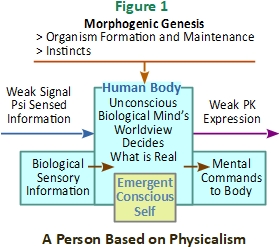
Part of my effort has been to model our mind from what I think is the perspective of mainstream science by using the same technique I used to develop the Pragmatic Model of Reality. Figure 1 is the result.
Physical Mind
As I understand the mainstream Physicalist view of a person, the biological organism that is our body is produced via some sort of morphogenic process that also embeds operating instructions and survival instincts into the resulting brain.
According to mainstream science, our mind is produced by the biological brain. It communicates with our body by sending movement instructions such as walking and speaking commands. Our body’s five senses are the primary inputs for our mind. Although mainstream scientists might not refer to mind as a storyteller, in practice, our mental storytelling processes produce such experiences as dreams, feelings and wants. First Sight Theory does a good job of modeling our mental storyteller.
Many researchers allow that some extraordinary people are modestly able to psychically sense information (aka anomalous cognition) and are able to produce modest psychokinetic influences. That is the main argument of First Sight Theory (“Fist Sight” meaning psychic sensing). (See https://ethericstudies.org/first-sight-theory/)
Nonphysical Mind
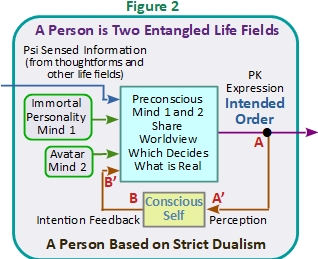
Now consider the Figure 2. It represents how a person is modeled in the Pragmatic Model of Reality. The diagram will make more sense if considered from the idea that we are “spirit having a human experience.” That idea alone implies that a person is best defined as a relatively immortal personality entangled with a human in a symbiotic-avatar relationship. If this is true, we are of two minds competing for dominance of our body and its expressions.
Expression and Perception
It is useful to think of our unconscious mind as a streaming storyteller explaining what it thinks of sensed information. Our mind’s Expression output signal is that story. Remember that it is always modified by the point of view represented by our worldview.
While the Psi sensed information input includes information from our body’s five senses, the expression signal also represents commands to our body.
Our conscious perception is based on our unconscious expression signal as indicated by the orange line in Figure 2 that connects the Expression signal with Conscious Self (A-A’). The idea that our expression of what we think precedes our awareness of what we think. You can demonstrate this idea for yourself by contemplating the mental process you use to search for a memory.
Conscious Self
Based on our experience with mediumship, psychic functioning and ITC, we are pretty sure that our conscious self is not an emergent quality of unconscious mind. It is a discrete functional area that functions as our mind’s Experiencer. Conversely, the unconscious functional area of our mind is our Judge and Navigator which is moderated by our worldview.
The conscious functional area of our mind represents the functional mental areas involved in how we make decisions. We consciously examine our perception (from unconscious mind) to decide if we agree. We send a signal to our unconscious mind to say 1.) we agree—maybe strongly agree—with what it has just expressed; 2.) If we are indifferent about it; or, 3.) If we want to change what was expressed.
It is by way of the feedback signal from Conscious Self to Unconscious Mind (B-B’) that we consciously express our intention (our want). This feedback is always moderated by our worldview. Our worldview is generally only gradually changed, so that we probably must express the same “want” many times, even habitually. In theory, the greater our lucidity (aka spiritual maturity or progression), the more effective is our intention feedback.
The A-A’ to B-B’ circuit represents a mental function that allows us to consciously express what we want our mind’s outward psychokinetic expression to impress on the world around us. We see this effect in ITC as “Intended Order” as our etheric communicators (impress images and sounds into our media. This effect is also evident in the way random event generators change in randomness when a strong psychokinetic influence is present.
If you review the “What ITC Tells us About Consciousness” paper, you will see that ITC has provided important hints about the way mind works. https://ethericstudies.org/what-itc-tells-us-about-consciousness/
What to do
So why is there a difference between the mainstream view of our mind illustrated in Figure 1 and the Implicit model of our mind illustrated in Figure 2? My speculation is that ITC has proven to be “a bridge too far” for mainstream academia, even most parapsychologists to accept.
It appears that most parapsychologists are employed by or retired from universities. Points of views in universities tend to have momentum that is resistant to new ideas. Another possibility is that, with a very few exceptions, researchers are psychologists and philosophers while ITC is a technology intensive form of transcommunication. The idea of intended order requires a hug leap into the world of abstract concepts rather than physical objectivity.
ITC practitioners are mostly in the lay community and there is little lay-to academic exchange of information. We can improve that by making sure only Class A examples are shared on the Internet. One of the most common reason academics reject ITC is that they have found mostly unintelligible examples on the Internet. They often say that they have reviewed the Jürgenson and Raudive examples and think they are just noise. We have to do better if we want to get past the current Physicalist dominated paradigm.
You can see this paradigm in action by reviewing what, if anything, the essayists said about ITC as proof of survival for the BICS Essay Contest. See https://ethericstudies.org/bics-2021-essay-contest-proof-of-survival/.
If you are communicating with scientists, send this post to them and ask for their thoughts. Figure 2 need not be right, only indicative. The real question is why they are ignoring ITC in their consciousness studies. Alternatively, can they tell us why ITC is not paranormal?
As always, I would benefit from your comments.