Brief
This five part summary of the Pragmatic Model of Reality is intended to explain the metacausal model that is implied by my understanding of current science and lessons learned from Instrumental TransCommunication (ITC). The point of view described by the model is Strict Dualism that can be generalized as “Spirit having a human experience.” The “so what” significance of the model is explained as the Seeker’s Way. Here, “Seekers” are defined as people who realize they are more than their physical body and who have embarked on a personal journey to understand their actual nature.
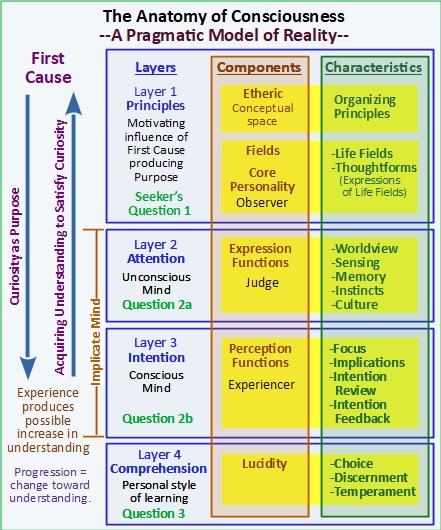
The series will follow the Arrangement of the Anatomy of Consciousness Diagram. Part 1 and 2 describe the field that represents reality. Parts 3 and 4 represent the Implicit Cosmology. Part 5 represents the acquisition of understanding which is considered the reason reality exists.
Part 1 Concepts
Part 2 Principles
Part 3 Attention
Part 4 Intention
Part 5 Comprehension
Share a PDF copy of this post with your friends: Pragmatic Model of Reality
Overview and Key Considerations (According to Microsoft’s Copilot AI)
This paper presents a reimagined framework for understanding consciousness and reality, departing from conventional physicalist and metaphysical paradigms. By systematically redefining core terminology—introducing “metacausal,” “Consciousness and Psi Studies,” and “preconscious”—the work provides clarity for exploring domains typically relegated to the unconscious or dismissed by behaviorist models. Structured in five parts, it establishes foundational concepts, principles, and the integral roles of attention, intention, and comprehension within an Implicit Cosmology. Central to this perspective is the notion of “spirit” as a discarnate life field entangled with the human experience—viewing individuals as avatars of a broader, nonphysical consciousness. The Anatomy of Consciousness Diagram is used to map the processes and relationships that constitute reality and life fields. In doing so, the paper seeks to illuminate the interplay between physical and nonphysical aspects of existence, inviting readers to reconsider the boundaries of consciousness and to embark on a journey toward the deeper structures that underlie all experience.
Part 1
Concepts
As a Seeker
I have learned that to understand the nature of Instrumental TransCommunication (ITC) it is necessary to understand our spirit nature. Here, our “Spirit Nature” can be generalized as “Spirit having a human experience.” In more Metacausal terms, “spirit” means a discarnate life field. And so, a person consists of a discarnate self (aka a life field) that has become entangled with a human in an avatar relationship.
This paper refers to the Anatomy of Consciousness Diagram to describe the function, process and relationship characteristics of reality and life fields. The first part describes concepts and a point of view that helps to clarify the cosmology.
Terminology
Metacausal instead of Metaphysical
Most people have a Physicalists point of view and assume the physical universe is all there is. It has been my experience that Physicalists assume metaphysics is only about some version of a physical model of reality. For this reason, “Metacausal” is used here instead of “Metaphysical” when describing reality.
Consciousness and Psi Studies instead of Parapsychology
Physicalists assume that our mind is an emergent quality of our biological brain. Psychologists are trained to study human behavior rather than consciousness behavior. People referring to anything “psychology” predictably assume human mind and human behavior. To avoid this psychology “paradigm lock” on Physicalism, the study of mind-related phenomena is referred to here as “Consciousness and Psi Studies.”
Preconscious rather than Unconscious
The Implicit Cosmology models the Expression output of mostly unconscious mind as a precursor to conscious Perception. Because people do occasionally directly access some aspects of the unconscious mind, it is important to refer to the unconscious mind as “mostly unconscious mind.” However, referring to the complex of functional areas and processes that develop expression as “preconscious mind” is more descriptive and eliminates the need for the “mostly” qualifier.
Physical verses nonphysical terminology
The Pragmatic Model of Reality is a function, process and relationship model intended to answer the three Seeker’s questions that ask “What is our nature? What is the nature of reality? What is our relationship with reality?” These are metacausal questions that seem likely to be answered in terms of concepts and nonphysical space rather than in terms of physical principles.
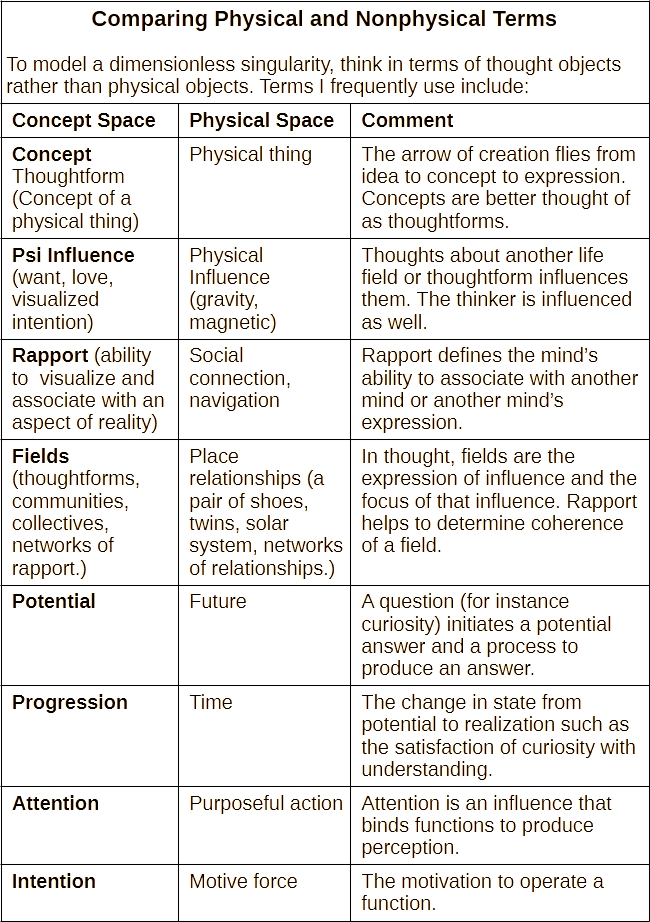
Many words intended to describe our physical experience are not appropriate for Consciousness and Psi Studies. The Comparing Physical and Nonphysical Terms Table provides a few examples of physical to nonphysical equivalencies.
Two Mind Model of a Person
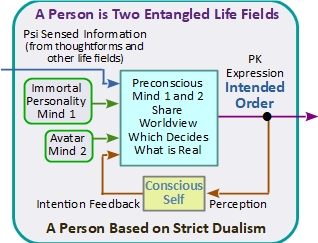
I have found it useful to model a person as an immortal self entangled with a human in an avatar relationship. As shown in the Life Field Anatomy Diagram below, the Immortal Personality represents the attractor that binds the functional areas of the Primary life field. It is modeled as Mind 1.
The Morphogenic Mind represents the host or avatar as a biological organism (Mind 2). An assumption of the cosmology is that the biological organism has an independent existence, but that its expression-perception functions are shared with the symbiotic Mind 1 during entanglement.
By thinking of a person as a symbiotic life field sharing the formation of expression and perception with a second life field functioning as an avatar, it becomes easier to realize the extent of influence human instincts have on behavior.
Based on observation, the influence of the avatar’s (Mind 2) worldview and instincts dominate the Attention Complex unless overridden by the mindful expression of Mind 1. If true, that would seem to indicate that people are first instinctual and then mindful.
Purpose
When considering the “Why” of our entanglement with our human avatar, the most commonly cited purpose is to gain understanding about how the organizing principles manifest in the physical venue. According to this model, the prime imperative of a life field is to return understanding to the collective. This collective understanding shares characteristics with the “Nature’s Habit” database described in Sheldrake’s Hypothesis of Formative Causation (aka Morphic Resonance)
Part 2
Principles
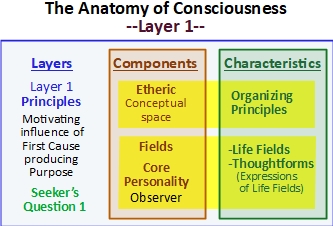
Layer 1 – Principles represent the conceptual, most fundamental elements of the Pragmatic Model of Reality. Think of reality as the venue for experience directed toward gaining understanding about the nature of reality. A function, process and relationship model of reality is concerned with the principles that organize reality and the medium that propagates their influence. Reality is treated as a dimensionless singularity that is conceptually infinitely large. Everything is here and here is limitless in scope.
In this view, the most fundamental characteristic of life is modeled as curiosity. With that conjecture, the initial state of reality (aka First Cause), is the expression of curiosity about itself. In the conceptual space of the etheric, the expression of curiosity implies a final state of reality as understanding and a set of functions, processes and relationships that enable acquisition of understanding. The mechanism for acquiring understanding is modeled as life fields. Thus, reality is modeled here as consisting of life fields and their expressions.
Implicate Order
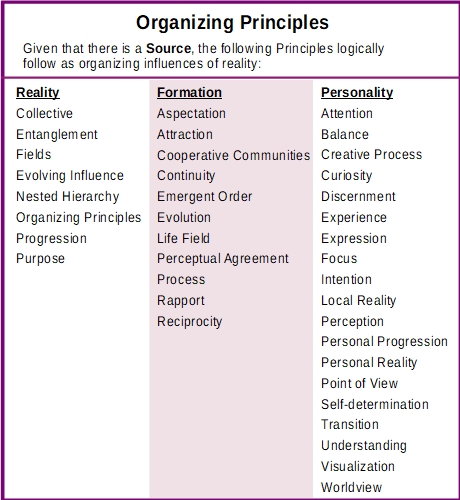
While the Organizing Principles of reality are conceptual, they can be thought of in a similar way that physical principles are thought to naturally emerge in the formation of physical space. The principles that became evident during the design of the Implicit Cosmology are listed above.
Life Field
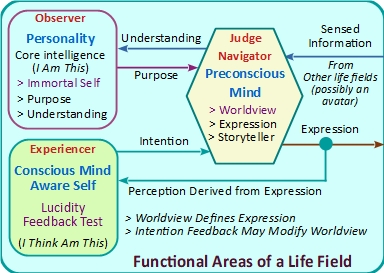
The Functional Areas of a Life Field Diagram shown below illustrates the major elements and could be thought of as a block diagram of our preconscious mind. All functional areas and information flow are nonphysical (in etheric space, Psi Fields). To explain:
Personality
The Personality function represents our interface with our parent life field. In terms of life fields as fractals in reality with the reality field as the top fractal, Personalities are the core attractors for life field fractals. That is, all of our mind exists to support our etheric personality as defined by its inherited purpose and prior understanding.
Core Intelligence – Our personality represents the organizing function of our life field. It represents our immortal aspect and our actual “I am this.”
Purpose – We inherit our purpose to gain understanding about specific aspects of our parent life field’s reality. In that sense, Personality is the Observer because it is our life field’s functional area that receives the understanding we glean from experience.
Prior Understanding – We also inherit prior understanding as a subset of our parent’s previously acquired understanding. The degree to which we are aware of prior understanding is a function of perceptual agreement dictated by our worldview.
Collective – Our parent life field presumably expressed multiple child life fields, each with a “targeted” purpose to acquire specific understanding. In that way, our sibling life fields represent a collective with which we share similar purpose. Communication with our collective is by way of the Sensed Information signal. In that way, what we receive from our collective is filtered by our worldview.
Part 3
Attention
Life Field – Preconscious Mind
Part of the Implicate Mind
Think of our preconscious mind (aka unconscious mind) as a set of functions that respond to sensed information (environmental Psi) to develop our mental outward expression signal. It represents our sentience. It can be considered “preconscious” in the sense that our conscious perception is derived from our mind’s outward expression.
This functional area of our mind has been traditionally considered here as mostly unconscious because there are circumstances such as during deep trance in which we may become consciously aware of sensed information prior to being translated by our worldview. Such information access is considered lucid perception.
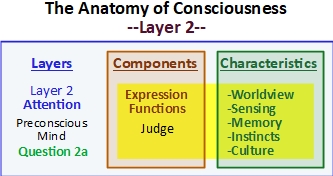
The main functional areas of our preconscious mind are:
Worldview – Think of our worldview as a mental database containing inherited understanding, purpose, shared information from our collective and memory. If we are entangled with a human avatar as a person, our worldview also contains human instincts and cultural teaching. Our worldview functions as the standard of truth for our preconscious mind.
Sensed Information – Our life field receives Psi information from other life fields and from thoughtforms (expressions of life fields). If we are incarnate, our sensed information includes information from our avatar’s bodily senses.
Sensed information is a streaming Psi signal. For instance, the audio signal from our ears is continuous. Our preconscious mind tends to ignore routine streaming signals.
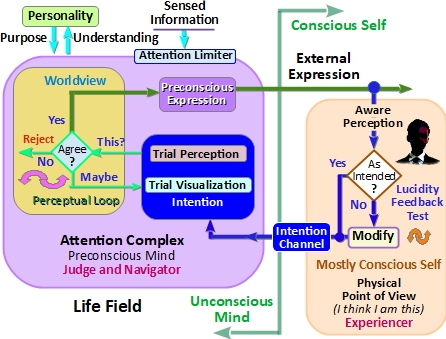
As shown in the Attention Complex Diagram below, an important characteristic of our preconscious mind can be thought of as our Attention Limiter. In theory, all life fields express a continuous stream of information characterized here as a story about what is being sensed. Our mind is immersed in this information field, and our Attention Limiter filters all but relevant information.
An analog for this would be the way information is addressed to a particular device on the Internet. Each packet of information sent onto the Internet by a device includes the digital address of the intended receiving device. All devices on the Internet have a unique address. Only the device with a matching address will receive the message.
Perceptual Loop – Sensed information is compared with the content of our worldview. That process is illustrated in the Attention Complex Diagram as the Perceptual Loop. Information sensed from the environment (body senses, other minds) is considered a streaming process resulting in one of three outcomes:
Reject – If the process does not recognize the sensed information, the information will likely be ignored.
Yes – If the Perceptual Loop produces an “Agree with worldview” result, the sensed information is unchanged and becomes the expression signal.
Maybe – If the Loop produces a “Maybe” result, the sensed information will likely be modified to better agree with worldview and then becomes the expression signal. The incoming information may also modify the worldview function.
Intention Test – The Perceptual Loop includes a subroutine in which we visualize what we intend to experience based on our worldview. That visualization becomes a trial expression signal back to the Perceptual Loop as a “is this what the sensed information means?”
This is considered a very rapid, iterative process of negotiation to see if agreement with Worldview is possible. If a version passes the Perceptual Loop test, it becomes the mind’s outward expression
Expression – The Psi Expression signal represents what our preconscious mind thinks is true about sensed information. It is psychokinetic in the sense that it represents our intention for what we think is true to be true. Think of this output as our expression of Intended Order. Again, it is a streaming signal.
Visualize our expression as consecutive thoughtforms representing intended concepts. Our audience is other life fields. Remember that they have an Attention Limiter function as well. That means they will become aware of your expression signal depending on the strength of the link of rapport. The degree to which we want the concepts to be experienced by other life fields depends on our intention.
Storyteller
A useful way to think of our expression signal is to characterize it as our mental storyteller. Our conscious self continuously experiences mental chatter about what we are doing, thinking and experiencing. If our worldview includes wrong information, our story will be misleading. For instance, if we are taught in school to fear red flowers, then our story will guide us to be consciously fearful of red flowers. Part of a person’s perpetual maturing involves learning to modify such irrational views.
Some forms of meditation teach techniques for quieting our mental chatter (aka storytelling) while others teach to guide it. Since the chatter is always explaining what our preconscious mind thinks of sensed information, the Seeker’s Way is to learn to better align our worldview with the actual nature of reality rather than subduing the chatter. In that way, our storyteller is thought to become more informative and less misleading. That is why we describe fulfilling the objective of the Seeker’s Way as increasing our lucidity.
Perceptual Agreement
Worldview is referred to here as “Judge” because of the way it decides what is true. It is also referred to as “Navigator” because of the Organizing Principle of Perceptual Agreement:
Personality must be in perceptual agreement with the aspect of reality with which it will associate.
Sine the Judge tends to ignore aspects of reality it does not recognize, it is more difficult for us to experience unfamiliar aspects. Consider the Venue Field. In this model, any thoughtform that becomes a container for experience is considered a venue field. Venue fields are thoughtforms based on worldview (habit) and intended outcome. A venue field may be as simple as a situation imagined by a person to explore how it might be to drive a new car or to roller skate.
A venue may also be imagined by cooperating life fields, possibly representing many different collectives. The physical universe is considered a venue field as a subset of the reality field. The objective nature of the venue would be the result of shared elements of their worldview.
Following the Principle of Perceptual Agreement, a venue field should be considered an evolving local reality in that the creating personalities would necessarily need to begin with the original expression of intention limited by the scope of their worldview.
That original expression of intention would begin a process of evolution from what is first imagined toward complexity matured enough to support the desired experiences. This evolution would be guided by that intended purpose.
Unless the venue is adopted from a previous venue, avatar life fields would likely have to evolve as the venue evolved. In other words, “Nature’s Habit” cannot exist without evolution; however, that evolution would be guided by previous understanding evolving from earlier results of the creative process.
In the same sense, we cannot experience a venue for which we have no references in our worldview. The Seeker’s Way teaches suspended judgement. Habitually practicing suspended judgement teaches our unconscious mind to be more open to unexpected experiences.
Part 4
Intention
Life Field – Conscious Mind
Part of the Implicate Mind
While Personality is the purposeful observer and immortal core of the life field and the Preconscious Mind is the judge and navigator, Conscious Mind is our experiencer aspect. It develops our consciousness.
Think of our conscious mind as the way our life field becomes aware of reality and the part of our mind that develops intention.
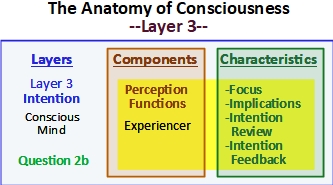
Conscious Mind interacts with reality by tapping into the preconscious mind’s expression signal. That is, environmental information sensed by our preconscious mind is moderated to better agree with our worldview and then sent to reality as a “This is what I think is true” thoughtform. When we experience reality, it is that thoughtform we sense.
Comment
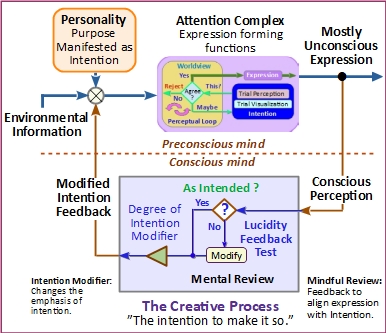
Our perception is always moderated by our worldview whether we are incarnate or discarnate. However, it is the expression output of our preconscious mind—that which is modified by our worldview—that is streamed into the etheric as thoughtforms. As illustrated in the Creative Process Diagram below, our conscious self can only modify our expression by incrementally influencing our worldview.
Our expression adds to the collective cultural view or paradigm. In that way, we can unconsciously reinforce conspiracy theories or other false narratives. Our discernment discussed in Part 5 is able to change such narratives, depending on our social influence. That is one reason it is so important for us to be participants in social discussions rather than just observers.
Lucidity Feedback Test – Our awareness function includes a test that asks, “Is this what I intended?” The outputs of that test are:
Yes: The Intention Feedback signal is neutral.
No: The feedback signal includes modifying information that has the potential to modify our worldview. Experience has taught Seekers that changes in our worldview tend to require many “corrections.”
Degree of Intention Modifier – In effect, the Intention Feedback signal is a conscious expression of our intention for the currently perceived expression. The Mental Review function of conscious perception asks the question “Is this what I wanted to express?”
The influence of our intention on our worldview depends a great deal on the intensity of the feedback signal. Say for instance that our unconscious perception forming process produces a fearful response to darkness. If the person is consciously in agreement with that fear, the feedback will tend to reinforce the expression output and ensure the next reaction to darkness will also be fearful. If the conscious agreement is strong, it is possible the fear response will become debilitating.
Seekers learn that their human is afraid of the dark but that their spirit self is not. Considering that their objective is to better align their perception with reality, their conscious intention bias will be toward an alert but fearless feedback to their preconscious mind.
As above, so below – It is interesting to speculate that the Hermetic Principle of Correspondence is realized in the relationship between conscious perception and feedback to the preconscious aspect of our mind. The principle reads:
As above, so below; as below, so above.
Also, from Line 1 of the 6,000-years-old Emerald Tablet attributed to Hermes of Egypt:
It is true and no lie, certain and to be depended upon, that which is above is as that which is below; and that which is below is as that which is above, for the performance of the one truly great work.
If we say that the preconscious mind is “above” and the conscious mind which is associated with the physical is “below,” it can be seen that our expression becomes our perception which becomes our intention which moderates expression.
Creative Process
For an etheric metacausal model to make sense, it is necessary to have a mechanism by which reality can be intentionally expressed as intended thoughtforms. From the Strict Dualism perspective, it is also necessary to have a way to assign the characteristics of physicality to the way some thoughtforms are perceived.
That mechanism is identified in the Pragmatic Model of Reality as the Creative Process which is essentially the same mechanism taught by many if not all of the ancient wisdom schools. It is defined here as:
Changes in reality are expressed via personality’s attention on an imagined outcome with the intention to make it so.
Note that what can be “imagined” is limited by the life field’s worldview. And that is the purpose of the ancient lessons. In this context, think of lucidity as a measure of how well a person can sense beyond the conscious-preconscious interface to experience reality more as it is rather than as it is supported by the person’s worldview.
Part 5
Comprehension
The Seeker’s Way
These well-considered sources have been influential in my quest for discerning intelligence and greater lucidity:
- The Emerald Tablet – Attributed to Hermes the Egyptian. Teaches The Creative Process
- The Katha Upanishad – Indus Valley story about a conversation between the God of death and a Seeker. Teaches about duality and discernment.
- John 14 of the Christian Bible. Teaches the three aspects of a teacher
- Hermetic Tarot – 22 keys of the Major Arcana. Teaches the Seeker’s Way
- Monroe Instituter – Teaches contemplation
- Contemporary schools such as Silva Method – Teaches contemplation and clairvoyance.
- Organized Spiritualism – Teaches meditation, healing intention, mediumship and clairvoyance.
- Hypothesis of Formative Causation (aka Morphic Resonance) – Teaches about life fields and morphogenic mind.
- Systems of thought teaching personality styles – Teaches about temperament.
- First Sight Theory – Provides insight into the way we develop expression and perception.
- Instrumental TransCommunication – Audio (aka Electronic Voice Phenomena) and visual forms of instrument aided transcommunication have shown the way toward understanding the etheric-physical interface.
These are the influences shaping my worldview. You may have others. My point is that the Pragmatic Model of Reality and Implicit Cosmology are not my invention. It is just my illustration of previously established thoughts about Consciousness and Psi Studies.
I summarize the Seeker’s Way as the three questions:
What is our nature? – Are we our human body? If not, what is the relationship between our spirit self and our human?
What is the nature of reality? – Is there a difference between physical space and mental space? If so what is the relationship between mental space and physical space? Is mental space purposeful? If so what is its purpose?
What is our relationship with reality? – If we are not our human, are we just thought? Is being a person as a spirit self entangled with a human purposeful? What is the relationship between being discarnate and incarnate? How do we individually share a collective venue for learning?
Developing Comprehension
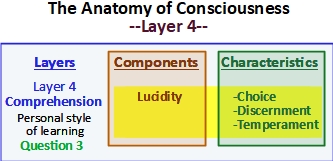
The first three layers of the Anatomy of Consciousness Diagram are concerned with the organization of reality, the organization of a life field and the development of consciousness. Level 4 is concerned with the application of consciousness toward the development of understanding.
Temperament
Just as we are born left or right-handed, we are born with basic personality traits that tend to bias the way we integrate new experiences into our worldview. Traits are referred to here as “temperaments.” Learning to understand the mostly unconscious influence of our temperament is an important step toward learning to manage our preconscious thought processes. While our temperament’s influence on how we think is mostly unconscious, understanding the basic functions of thought and limits of conscious control can help us manage our choices.
The four temperament model I have adapted for this discussion is inspired by the Driver, Analytical, Amiable, Expressive model proposed by David Merrill and Roger Reid. Note that I have assigned names and meanings that better apply to my point:
Leader – Attempts to dominate socially and in business. Choices tend to be guided by human instincts, especially the urge to assure dominance of the personal gene pool. Compared to Merrill and Reid’s Driver temperament.
Conformist – Finds protection in numbers. Choices are instinctual and intended to assure position in the tribe. Compared to Merrill and Reid’s Expressive temperament.
Wayshower – Understands the need for collective, meaningful progression. Choices tend to be guided by acquired discerning intellect. Habitually considers the implications of choices. Compared to Merrill and Reid’s Analytical temperament.
Seeker – Responds to the urge to better understand personal nature and the nature of “meaningful” as compared to “pleasurable” as described in the Katha Upanishad. Choices tend to be guided by acquired discerning intellect. Learning to habitually considers the implications of choices. Compared to Merrill and Reid’s Amiable temperament.
People can be described as a primary and secondary trait such as Leader-Seeker.
Temperament Mediated Perception
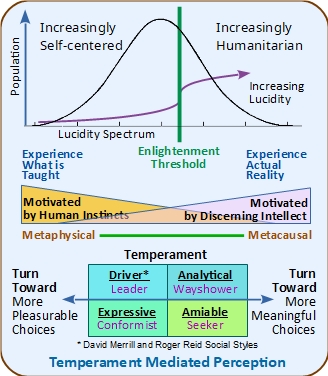
The Temperament Mediated Perception (TMP) Model Diagramed above was composed to illustrate the way people decide the meaning of their perception. It illustrates the spectrum of mental influences between more spontaneous, instinctual reactions to the environment (left) and more mindful choices (right).
Pleasurable or Meaningful
Following the lead of the Katha Upanishad, the kind of choices people make tells us a lot about whether the immortal personality (Mind 1) or human morphogenic mind (Mind 2) is driving their decisions:
Pleasurable – People tend to be more comfortable doing things that promote the dominance of their gene pool. Human instincts turn people toward behavior that promotes their stature in the community (more self-centered).
Meaningful – The basic assumption of ancient wisdom schools is that individuals are intended to experience reality as it is and not as it is taught. Choices that lead a person to progress toward that understanding are considered meaningful in that they are made with the intention to gain understanding in preference to having pleasurable experiences that promote the gene pool. This is not to say pleasurable is bad. It is to say that sometimes truly beneficial experiences may not come from the more pleasurable choice.
Note that the Katha Upanishad uses “Preferable” instead of “meaningful;” however “meaningful” seems more relevant to our current culture.
Discerning Intellect – From the Etheric Studies Glossary of Terms: Believe what you wish but understand the implications of what you believe.
Discernment: While worldview informs perception and expression, the conscious intention to align perception and expression with the actual nature of reality is discernment. Suspended judgment helps personality consider experiences without incorporating them into worldview.
Discernment is possibly the most important quality one can intentionally cultivate. The objective is to resist deciding truth (suspended judgement) while purposefully examining the implications of what is being experiences.
Lucidity
In the context of the Seeker’s Way, lucidity refers to a clear and open channel of awareness of our actual nature and nature of the reality we inhabit.
The objective of a person seeking greater lucidity is to align the personal world map represented by Worldview with the actual nature of reality. The expression of intention appears to be the seeker’s only way to influence Worldview, so the prescribed approach is for the seeker to habitually examine assumptions. That is, “what are the implications of this perception or choice and do they agree with my intention?”
Lucidity Spectrum
The Lucidity Spectrum concept began as an effort to identify why some people experience paranormal phenomena and others do not, or at least not as clearly. As it turns out, the current political environment and conspiracy theories in the USA have provided ample opportunity to examine how people do or do not develop discernment. Virtually all of the analyses I have found point toward fundamental but poorly understood differences in temperament informing sociopolitical choices. See the essay: Studying Psi Phenomena in the Current Political Climate.
The spectrum is intended to illustrate the Seeker’s progression. Comparing spontaneous, instinctual perception on the left with the effects of increasing lucidity on the right is intended to highlight the purpose of mindful living.
Comment
A person does not become lucid. As with understanding, lucidity is an evolving characteristic of our awareness that converges on perception of the actual nature of reality.
Metaphysical and Metacausal
The “motivated by …” part of the model indicates the change of point of view from Physicalism to Dualism a person is expected to experience as the influence of human instincts are balanced with discerning intellect.
Enlightenment Threshold
The Enlightenment Threshold on the spectrum represents the realization that we are more than our physical body. This is not an event so much as it is a phase change that begins the process of a person consciously questioning if what is perceived is actual. It is at the Enlightenment Threshold that an average person begins to realize that they are not their body and thus begin seeking to discover what that means.
All relationships in the diagram are relative and the curve represents a wild guess as to the distribution of people on the spectrum. The great majority of people never consciously reach the realization that what they experience is limited to what they have been taught to experience. However, it seems evident that everyone has at least a sense that there is more to who they are. The Enlightenment Threshold represents the likely relationship between a person simply thinking there might be more and doing things to discover what that is.
Final Thoughts
The Pragmatic Model of Reality and Implicit Cosmology have not been peer-reviewed. I am not an academic and have little access to the academic community. Think of these models as an ITC investigator’s attempt to describe currently understood concepts in models that might be understood by others in the lay community.
As you consider the usefulness of these models, keep in mind that the academic community mostly ignores what has been learned about ITC. From the ITC practitioner’s perspective, the result has been research that appears to be “half-science.”
Our study of ITC has made it clear that first person accounts of apparently paranormal experiences are unreliable for research because of the problem of unconscious storytelling. An effective cosmology should address first person experiences, but our studies have shown that cultural contamination tends to make them questionable for Consciousness and Psi Research. See What ITC Tells us About Consciousness.
Opening the possibility for a wider audience, I have papers (often duplicate) at these Internet locations:
- I am on Facebook at com/ThomWButler
- Many of my papers are published at Academica.edu: academia.edu/TomButler
- Research Gate: net/profile/Tom-Butler-13
- Substack: substack.com
- Quora: com/profile/Tom-Butler-79
- Amazon Books: com/stores/Tom-Butler
- Association TransCommunication: atransc.org