

Illustration is based on Bubble by svstudioart, freepik.com
Content License for this Opinion: Creative Commons Attribution-NonCommercial-ShareAlike 4.0 International
Brief
The Frame of Reference concept, which is concerned with the relationship between mind, consciousness and perception, is explored in this paper based on a Pragmatic Model of Reality and its included Implicit Cosmology of mind. Pertinent concepts are briefly explained and related in a logical progress to show that we are first nonphysical, nonlocal life forms. And, that our sense of what is physical is shaped by aspects of our worldview that are informed by a collective of life fields. The objective of this paper is to show that we are able to experience other aspects of reality, other frames of reference, by teaching ourselves to be less certain about what is real. Some of us at least occasionally spontaneously, usually momentarily, experience this altered state.
Abstract written by Microsoft’s Copilot AI based on the current content of this paper:
This paper advances a Pragmatic Model of Reality, positing that the essence of experience is fundamentally nonphysical and nonlocal. Drawing from an implicit cosmology of mind, it contends that our sense of physicality and the boundaries of what we consider real are collectively constructed through interrelated worldviews. The model proposes that by consciously reducing our certainty about the nature of reality, we can momentarily access alternative frames of reference and broaden our experiential horizons. Through logical progression and reference to spontaneous altered states, the discussion illuminates how meaning and relationship, rather than physical constructs, serve as the foundation for consciousness and reality. This empowers individuals to reimagine the constraints of time and space and engage more freely with the dynamic processes that underlie existence.
I have to admit that I like the AI version better than my own. It is more approachable. It is as if someone else has read my paper and recommended it to a friend.
Content
Brief
Frame of Reference
Life Field
Thoughtforms
Collective
Venue for Experience
Shared Frame of Reference
Changing Frame of Reference
Alternative Frames of Reference
Two Times
Concluding Remarks
References
Frame of Reference
The Pragmatic Model of Reality is a function, process and relationship model. In it, reality is considered an entirely mental field (Psi, Psi field, etheric) with curiosity as its initial state of formation and understanding as the expected final state. The complementary extremes of curiosity and understanding imply a mechanism to facilitate the acquisition of understanding that will satisfy curiosity. Naturally occurring (implicate) organizing principles emerge from that mechanism.
This is not a “god” model. The source of curiosity is not identified. Instead, impersonal curiosity is stipulated as the most fundamental characteristic of reality.
The curiosity-understanding fundamentals of reality are present in the model to establish a context for the Implicit Cosmology (1) which is a model of a life field. That metacasual cosmology was developed based on my understanding of science to provide a mechanism to understand Psi phenomena, especially Instrumental TransCommunication (ITC). (2)
The set of functions necessary to acquire understanding are modeled as life fields (fractals) and their expressions. Life fields are related to parent life fields in a many-to-one nested hierarchy that increases in complexity and quantity from the initial expression of curiosity toward the implications of greater understanding.
Life Field
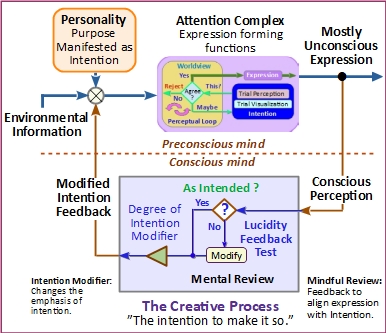
Every instance of life is modeled as a life field and every life field senses and expresses information in service of the acquisition of understanding. Life fields consist of these functional areas or complexes:
- Personality – An unconscious core Purposeful Function that represents purpose and acquired understanding (immortal self, Observer). This is the point of entanglement with the nested hierarchy between the parent life field and sibling life fields.
- Mind – A preconscious Expression Function that characterizes sensed information (storyteller) according to the life field’s worldview (aka reality map). This functional area is the life field’s Judge and Navigator. The outward expression signal is a preconscious streaming complex of thoughtforms.
- Consciousness – A conscious Perception Function that generates an intention feedback influence back to the Expression Function with the potential of modifying worldview. This is the life field’s conscious self. It is the Experiencer and the source of intentionality. The Experiencer perceives the outward expression signal of the preconscious mind and considers if it is what the conscious self intends (wants). The intention feedback signal is conscious self’s only influence on the worldview and expression forming process.
Thoughtforms
The life field’s expression influence is modeled here as a thoughtform. Sensed information consists of thoughtforms from other life fields. Characteristics of thoughtforms include:
- Thoughtforms are the product of mentation. They are our thoughts.
- Thoughts are modeled in parapsychology as “Psi.” Their influence is also modeled as “Psi” or “Psi functioning.” If thought manifests as a physical effect, it may be referred to as psychokinesis.
- Thoughtforms are modeled as a set of related meanings and influences arranged as a gestalt-like whole.
- They are hierarchical in that sets of concepts are associated in a basic to complex relationship.
- They are streaming in the sense that mind is always sensing, characterizing what is being sensed and expressing an opinion of what is being sensed (storytelling).
- Thoughtforms may also be modeled as individual concepts. In the etheric-physical relationship of Dualism, etheric concepts may be experienced as physical things depending on their assigned meaning.
Collective
The Pragmatic Model describes reality as evolving from the simple expression of curiosity to increasingly complex understanding. This evolution is modeled as life fields expressing aspects of themselves to explore potential characteristics of reality. Depending on the purpose, the resulting child life field may be autonomous, but its initial states of purpose, understanding and worldview are a subset of the parent’s.
The anticipated result of life field aspectation is a parent-to-many children relationship of life fields. Collectives are defined as a family of sibling aspects (life fields) with a shared parent life field.
A child life field is intended to experience a venue that is imagined by its parent life field which is based on a venue imagined by the super collective. The child life field’s inherited purpose is to derive understanding from those experiences.
Venue for Experience
In this model, when a life field intends to experience a characteristic of reality, it imagines a situation or venue that would support the intended experience and expresses an aspect of itself to participate in the imagined venue. The imagined characteristic of reality is modeled here as a venue for experience.
Imagined space is based on worldview. When a parent life field imagines a venue, its child aspects share the same venue.
In the Pragmatic Model of Reality, the physical aspect of reality is modeled as a venue for experience that is imagined by many parent life fields that are related in a hierarchy beginning with a top or pinnacle life field. In this view, the top life field is credited with initiating the venue and exploring its implications with one or more child aspects.
The resulting life field hierarchy for a major venue can be characterized as a pinnacle life field at the head of a super collective.
We often create venues for experience. For instance, I might imagine myself driving a particular sports car. My imagining would include visualization of the car, myself in the car and the experience of driving it.
In effect, I insert a “little me” or child aspect of myself into an imagined venue for experience. I give my “little me” a degree of understanding as a subset of my worldview and sufficient autonomy to experience the car and return to me a sense of what it would be like.
In that way, I have expressed many aspects which persist in my worldview and might be remembered for other experiences. Together, my aspects represent a collective.
Shared Frame of Reference
The Pragmatic Model holds that one or more pinnacle life fields imagined a venue for experience that eventually became the physical frame of reference. The initial characteristics of the physical would have been a subset of the worldview held by those initiating life fields.
The rapidly expanding singularity model known as the Big Bang origin of the universe is consistent with the Pragmatic Model. The Model’s Organizing Principle of Perceptual Agreement requires that new venues must be a subset of the imagining life field’s worldview). The principle is defined as: (3)
Personality must be in perceptual agreement with the aspect of reality with which it will associate.
The process of evolving a venue would involve having increasingly complex experiences. The effect would be that the initial life field(s) would be at the top of a “super collective” of life fields as each round of aspectation produces new local collectives of experiencing aspects.
Changing Frame of Reference
Traveling – In the Wizard of Oz, it is clearly Dorothy who experiences a shift in personal frame of reference. It is difficult to rationally speculate without more examples but people in Kansas may not be able to see Dorthy while she is in Oz. In the same sense, people in Oz would probably only be aware of Dorthy when she was “in” the Oz frame of reference.
Witnesses – When a person sees a cryptid, presumably from another frame of reference, the experiencer’s frame of reference probably does not change. For instance, a mountain hiker witnesses a Bigfoot across a clearing. In that moment, the hiker has not experienced a change frame of reference. Bigfoot is the “traveler.”
Alternative Frames of Reference
A Frame of Reference is defined here as:
A region of reality that is defined by a collective of life fields cooperating to maintain an evolving venue for experience.
It is difficult to argue the existence of alternative venues for experience—often referred to as alternate realities—when we are so solidly oriented toward our current venue. Our human avatar’s instincts have evolved here. Our science has certified the reality of our venue. Our experiences seem to tell us that we are our human.
But then we have our dreamscapes that force us to question the reality of our dreams. Do out-of-body experiences show us alternative realities? Is veridical information I psychically sense just my imagination?
Consider these possible indicators of the existence of other frames of reference:
(I am not claiming these examples as evidence. They are included here to illustrate how we might encounter an alternative frame of reference)
Apports
Apports are objects that are thought to be paranormally transported into a place from some other place. For instance, a flower petal might suddenly appear a few feet in the air before drifting to the floor. That was reported many times at Marcello Bacci sessions. (4)
My wife Lisa is a certified mental medium, and for a time, participated in the SORRAT Letter Writing Experiment. The reportedly paranormally written and delivered letters often included small, usually relevant objects. See “SORRAT – The Peculiar Outcomes of a Long Term Pk-Project” (5)
While attending a Spiritualist conference mediumship class, Lisa found a “Medium” stick under here chair. Later, while walking to lunch, she felt a second “Medium” stick in her shoe. Both are of the kind we sometimes received in SORRAT letters.
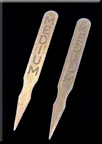
Of course, it is necessary to propose normal ways in which they came…perhaps the instructor had a trickster friend who knew of Lisa’s work with the SORRAT and was skilled in sneaking up on people. Apports typically violate all sensible expectations by just appearing without much explanation. See the apport article On Page 7 of the Summer 2002 ATransC NewsJournal.
Apports are presumably caused by a life field or group of life fields as a demonstration. Sometimes, they seem like a greeting as when a recently transitioned child begins leaving coins for loved ones to find. See the “Lance Alverson” article by Susie Alverson Page 3 on Page 3 of the Winter 2009 ATransC NewsJournal.
Following the Pragmatic Model, apported objects are thoughtforms that have been assigned their physical nature following the norms of our frame of reference. Presumably, they existed in one part of the world and their association with that location was changed to association with their new location. In that sense, only the location assignment of an apported object’s thoughtform is thought to have been changed. The intention of one or more life fields would be involved.
The effect is dissociation from one local frame of reality and reassociation with a new frame. Here, “association” is used to mean “identified with.”
Lucid dreamscapes
In Lucid Dreaming, our mind shows us vivid alternative views of our world. Sometimes it is as if we are taken on a journey to a new world. Examples in the literature include the way Dorthy finds herself in the Land of Oz and Alice finds herself in Wonderland. Children in our frame of reference are able to visit Peter Pan in Neverland. Are such story lines inspired by the author’s encounter with an alternative reality.
We need not be sleeping to have a lucid dream-like experience. I once saw a Commando Cody spaceship flying over my hometown. It was a perfect rendition of his ship that I remember from the movie matinees, even with smoke rising from the sparking tail.
Lisa reported a similar experience when, as a child looking out the front window of her home on Halloween night, she saw a witch on a broomstick hovering above the lawn. The witch smiled at her and flew away.
While working a gold club’s claim in the hills north of Phoenix, Lisa and I heard two adult women talking. Even with our clear view of the hillside, we could not see them. It seemed their voices were moving along a trail that was over a hundred feet in the air, as if they were in an alternate reality and only their voices impinged on ours. Others have reported similar experiences around that claim.
Gold club members occasionally reported seeing a man walking on a large gravel bar, also in the hills north of Pheonix. Lisa reported seeing the man. He was dressed in rugged cloths and was walking away from her as if she had just passed him … but had not. She saw him only once.
Following the Pragmatic Model, the circumstances suggest that we occasionally experience something for which our mind has no references. Our mind will either ignore the event or modify it to better agree with our worldview. Seeing a flying witch is sensible for a child’s response to seeing something flying just above the ground on Halloween, perhaps an orb.
The conjecture here is that we may experience something that appears real but that is actually from a different frame of reference (aka alternate reality).
Interstellar travel
Considering the great distances between stars, how could alien craft possibly come from other star systems? The distances are so great.
Following the Pragmatic Model, a craft could be apported. Some science fiction stories employee the storyline that interstellar travel is made possible with a person who identifies with a space craft and is able to associate itself, and therefore the craft, with alternative aspects of this universe … or an alternative reality.
Consider the Organizing Principle of Perceptual Agreement: (3)
Personality must be in perceptual agreement with the aspect of reality with which it will associate.
Our unconscious mind function is described as the Judge in the Pragmatic Model because that set of processes coordinates with our worldview to decide what is real about sensed information. It is also referred to as our Navigator because we normally experience only that which our mind can imagine.
The Frames of Reference concept provides a mechanism by which a mind might learn to disassociate its perception from its native frame of reference or world and associate it with a different frame. Some science fictions have used a concept similar to this. For instance, life fields with extraordinary mental tools function in these stories as “navigators” by mentally merging with the spaceship.
Author, Edgar Rice Burroughs illustrated this effect in his Barsoom stories. (6) Barsoom is the native Martian’s name for Marse. In the stories, the main character, John Carter, is able to change his perspective from his native life on Earth to Barsoom. In effect, teleporting himself back and forth between the two worlds.
Cryptids
There are reports of many creatures that if real, seem out of place. Using Bigfoot as an example, how is it possible for such large life forms to exist while leaving so little evidence of their presence?
Following the Pragmatic Model, if a life field was able to suspend certainty about the world it inhabits, it may be possible for it to “switch” to a different frame of reference.
Consider the fantasy novel I wrote titled Two Worlds, One Heart: (7)
The story
The main character, Jajeff, is part of a tribe living near a volcano that we know as Mount Saint Helens in our frame of reference. His people are hunter gatherers. Once, while contemplating a soaring hawk, Jajeff finds himself looking down at the forest from the hawk’s perspective. As the story goes, he finds that he is able to see through the eyes of animals when he considers them while in a meditative state. He is able to influence the animal’s to some extent, mostly by visualizing what he wants to see.
One day, Jajeff finds himself seeing through the eyes of a kitten chasing a string. When the kitten looked up at the person pulling the sting, Jajeff sees a woman his age and immediately falls in love. The reader learns that the girl lives in our timestream and Jajeff lives in a parallel, pre-colonization timestream.
The rest of the story involves the way Jajeff managed to change to the girl’s timestream and eventually return with her to his.
The concepts used in the story
The story depends on the relationship between perception and worldview. The idea is that our worldview contains the meaning our collective applies to concepts. Members of a different collective likely apply different meanings.
For instance, I perceive cars as engineering triumphs that are useful and enjoyable. Others might perceive cars as a simple utility. These differences may be evidence of different collectives.
A person from a primitive culture might see them as scary beasts. The way we understand the car concept is encoded in our worldview—mostly as cultural training and memory. A person from a primitive culture has no such training or memory.
Because everywhere is here in the etheric, we are exposed to the expression of all life fields but ignore all that are not pertinent to us. By communing with animals from the perspective of a hunter-gatherer culture, Jajeff might more easily relate to the animal’s expression.
You and I inhabit a much more determined aspect of reality that tends to make our sense of what is real more rigid. In principle, to see through the eyes of animals, it is necessary for us to learn to be more open to the unexpected. That is the usefulness of suspended judgement.
It is interesting that the Pragmatic Model indicates that remote viewing is not direct sensing of a distant place but is a mind-to-mind exchange with someone who is physically there or who has memory of direct experience.
Movement from one frame of reference (aka alternative reality, or timestream in my book) is conceptually the same as seeing through the eyes of animals. It was necessary for Jajeff to disassociate his point of view from his world and reassociate it with the girl’s world. He did this by confounding his awareness via a drumming ceremony while remembering what he had learned through the kitten’s eyes. We do this in a less objective manner when we participate in a guided, deep-trance meditation.
An underlying theory in this paper is that other life forms (cryptids) are able to change their frame of reference and may not be fully in this frame. Such near-physical visits might explain why reports of their existence are so persistent but with so little physical evidence.
Orbs
While most photographic orbs are just pictures ruined by flash-illuminated particulates or light flares, some orbs appear to be sentient critters.
The idea proposed here is that a life form may exist in a near-physical frame of reference that is able to partially “enter” the physical at will. Support for this idea includes:
- Orbs are usually self-luminous light balls that may be very small (inches) but some seem to be large (feet).
- They appear not to interact with physical substances. For instance, an orb reportedly flew through a hillside without disturbing the ground in an episode of The Secret of Skinwalker Ranch television program.
- Orbs reported as UFOs sometimes appear for a particular person.
- There is some evidence that they can be called, seeming to support the idea that they may be attracted to people. Some people appear to have more orb activity around them. For example, see Steven Greer’ Disclosure Project.
- Orb phenomena appear to be consistent with predictions of the Pragmatic Model of Reality. They model in the same way as cryptids, suggesting that they are just a different life form.
Bilocation, time slips and teleportation
There have been reports of encounters with people who are supposed to be in another place or time. It appears that most reports of such anomalous phenomena are found to be normal, misattribution or illusion. Some seem best explained with physical science.
The argument in this paper is that some experiences that remain unexplained might be evidence of a momentary shift in the experiencer’s frame of reference for their personal reality. An example for me came when I was attending summer camp near the Feather River Canyon in California. When I returned from a short hike, the camp leader told me that a man and woman had come looking for me.
The description of them was consistent with my mother and stepfather, they even correctly described the yellow convertible we owned at the time. The camp leaders told the visitors I was on a hike and so they left without leaving a message. Later, at home, I asked my mother about their visit, and she indicated that they had not been there.
Of course, I cannot rationally argue that the experience is evidence of anything like a time-slip or bilocation. However, it does seem that it was an instance of people being out of time or space. At least, it is the sort of experience that invites close examination. My practice is to maintain suspend judgement until more information comes in.
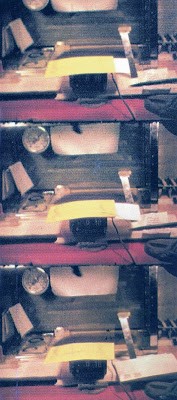
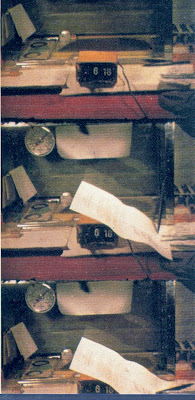
Left, “A letter is somehow transported out of an unopened envelope! Later, letters that were placed into the minilab vanished and resurfaced at a participant’s addressers by postal means.” Right, “one of the many direct writings that were produced caught on motion-triggered camera as it occurred. We see the pencil move upon a paper that was apported into the tank.” Pictures from SORRAT – or the peculiar outcomes of a long term pk-project.
Lisa participants in the SORRAT letter writing study. (5) Kai Mügge briefly described the paranormal letter writing experiment near the bottom of his SORRAT web page. One of the apparently paranormally written letters Lisa received was initiated by a participant who asked about time ships. Members of the spirit group known as the Imperator Group (8) had answered the letters while in the Mini-lab shown above.
The discarnate communicators said that some reported UFOs were actually time ships from our future. They suggested that sometimes the ships are cloaked for the wrong time. For instance, they might appear as a flying sailboat instead of a more appropriate shape such as an airplane. In theory, time travel is a change in frame of reference, even though it is still in our physical venue
Two Times
Time as Progression—Conceptually, the degree of acquired understanding intended to satisfy curiosity is modeled here as progression. Progression is the etheric equivalent of physical time. It is not linear and is probably not reversable.
Time as Evolution—If evolution is the mechanism that enables life fields to progress from an initial state of understanding to a more complete, probably more complex state, this venue for experience—the physical—theoretically began as the expression of the intention to understand the nature of reality when constrained by what we see today as an objective set of rules governing operation of the physical. Curiosity about the nature of an imagined venue is the initial state (the question). Understanding the nature of this imagined venue (the physical) would be the purpose.
In this view, fulfilling the purpose appears to be a nonlinear progression—more like punctuated gradualism in which understanding is gradually acquired one realization enabling another with occasional catastrophic changes in state. A volcanic winter or appearance of an alien culture would punctuate the otherwise gradual evolution in the physical.
Evolution of Meaning—The meaning we assign to a thoughtform determines how we experience the thoughtform. Perceptual agreement implies that the meaning assigned to a thoughtform by other life fields might not make sense to us. In that way, our perception is attracted to a different time and place with which we are familiar. That is, we tend to understand other life field’s assigned meaning in the context of our meaning.
It is important to remember that the physical is modeled here as a venue shared by many life fields. Think of this venue in terms of a super paradigm in which our avatar has evolved and that we are born into. As the ancient wisdom teaches us, breaking out of that paradigm is a journey requiring many mind changes.
In that model, traveling to a different time, say from 2025 to 1850, would require the experiencer to accept the 1850 assignment of meaning. Changing our perception requires a change in our preconscious-conscious relationship. Such a change in relationship involves our worldview. That requires our ability to suspend expectations of what is real. That implies a more conscious influence on our worldview than most of us have today. However, momentary slips in perception probably occur for some of us.
Concluding Remarks
If we are spirit having a human experience, if reality consists of life fields and their expressed thoughtforms, if reality is nonlocal in the sense that it is a dimensionless singularity that is conceptually infinitely large, then it is necessary for us to speak of consciousness and reality in terms of concepts rather than things. That is why I argue that a function, process and relationship model is appropriate for rational study of reality, our nature and our relationship with reality.
In that sense, we do not travel in reality. We assign meaning to shared concepts in the etheric that can be experienced as travel in the physical. This is not about a technological method for space travel or for entering an alternative reality. It concerns a way that we can change our thoughts in order to experience different realities. We are each time and space lords, if only we can learn to manage our worldview.
References
- Butler, Tom. “Toward a Consensus Cosmology.” Etheric Studies. ethericstudies.org/toward-a-consensus-cosmology/.
- Butler, Tom. “What ITC Tells us About Consciousness.” Etheric Studies. ethericstudies.org/what-itc-tells-us-about-consciousness/.
- Butler, Tom. “Organizing Principles.” Etheric Studies. ethericstudies.org/organizing-principles/.
- Tom Ruffles, Reviewer. “The Afterlife Investigations: Has Science Proved the Afterlife? DVD, by Tim Coleman (director).” Society for Psychical Research. spr.ac.uk/book-review/afterlife-investigations-has-science-proved-afterlife-dvd-tim-coleman-director.
- Mügge, Kai. “Society for Research in Rapport and Telekinesis (SORRAT).” Felix Experimental Group. kaimuegge.com/sorrat/.
- “John Carter of Mars®” Series. Edgar Rice Burroughs Library. com/series-profiles/john-carter-of-mars-series/.
- Butler, Tom. Two Worlds, One Heart. Edmonton, Canada: Commonwealth Publications, 1995. ISBN: 1-55197-053-8. Free PDF download at org/books-tom-butler/
- Tymn, Michael E. “Imperator and Rector.” Survival After Death. survivalafterdeath.info/spiritcontrols/imperator-rector.htm.